Showing posts with label Shakespeare. Show all posts

Thursday, December 1, 2022

& Juliet (Stephen Sondheim Theater)


By Harry Forbes

Here’s an often witty and generally clever feminist riff on “Romeo and Juliet.” In this telling, William Shakespeare's strong-willed wife, Anne Hathaway, strenuously objects to the original ending of the play and insists that after Romeo dies, Juliet ought to survive and have a happy life free from the strictures of the male dominated Verona. What ensues is a marital battle of quills, as the action plays out before us.


This happens to be a jukebox musical loaded with familiar top 40 hits by the producer/songwriter Max Martin and various collaborators (sharply orchestrated and arranged by Bill Sherman). So we hear familiar chart-busters from the likes of Backstreet Boys, Britney Spears, Bon Jovi, Katy Perry, and Kelly Clarkson, among others.


That utterly incongruous and anachronistic juxtaposition of contemporary song and Elizabethan era script make for a lot of the fun.


Juliet (Lorna Courtney), in David West Read’s amusing book, is a feisty gal who knows her own mind and decides to buck her parents Lord and Lady Capulet (Nicholas Edwards and Veronica Otim) and hit the road with her sassy nurse Angélique (a delightfully sharp-tongued Melanie La Barrie), and non-binary BFF May (touching Justin David Sullivan).


As Will (Stark Sands) and Anne (Betsy Wolfe) argue about the script, they themselves assume characters in the play: Will as a coachman and Anne as Juliet's worldly-wise older girlfriend April. 


Off they flee to Paris, crash a party hosted by rich kid François (Philippe Arroyo) whose stern father Lance (Paolo Szot in a delightfully wacky change of pace) wants the boy to wed or face life in the military. But (wouldn’t you know?) it’s attraction at first sight for the conflicted François and May and…well, you can guess the rest.


I suppose it’s only a tiny spoiler to reveal that Romeo does, in fact, make a second act appearance but, in this telling, it’s not necessarily a sure bet that he’ll reconnect with his former bride. (He was played by strong-voiced Daniel Maldonado at my performance, subbing for Ben Jackson Walker.)


Read’s book is a politically correct mélange of female empowerment, gay pride and identity, presented in a light-hearted, audience-pleasing manner. The show mixes elements of “Six,” “Head Over Heels,” and “Something Rotten.”


Southa Gilmour’s set is a colorful delight of flashing lighting effects, moving platforms, and air-borne set pieces. Paloma Young’s costumes are cheekily 16th century with a modern-day twist.


Lauren Courtney, in a stunning Broadway debut, raises the roof more than once with her powerful vocals and great stage presence. She has great comedic timing, and this is a real star-making performance.


Sands and Wolfe are strong as the battling Shakespeares, with Read’s script giving them some humorously sharp ripostes. All get their opportunity to shine vocally.


Szot, in a delightfully silly departure from his roles at the Met and as Emile DeBeque in “South Pacific,” really lets down his hair particularly in a second act boy band number, and he and La Barrie make a wonderfully daffy pair. (It turns out Lance and Angélique had a thing years before.)


The show opened in Manchester and then London’s West End in 2019 winning three Olivier Awards and it continues to run at the Shaftesbury Theatre there. If the reaction of the audience at my performance was any indication, I predict it will enjoy a comparably healthy run here.


(Stephen Sondheim Theatre, 123 West 43 Street; andjulietbroadway.com)


Photos by Matthew Murphy: (top) (l.-r.) Melanie La Barrie and Lorna Courtney


Below: (l.-r.) Stark Sands and Betsy Wolfe


Friday, February 25, 2022

The Merchant of Venice (Theatre for a New Audience)


By Harry Forbes


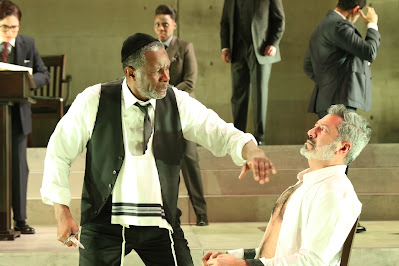
Director Arin Arbus’ production of “The Merchant of Venice” is outstanding in its clarity and fascinating in its take on this problematic play. Above all, it showcases a truly superb performance by the great John Douglas Thompson as Shylock, one of the greatest portrayals of the role I’ve ever seen.


The cast is uniformly excellent, and Arbus has vividly underscored the societal bigotry against Shylock on every level. The result is that the moneylender’s desire for revenge has rarely seemed so justified. A jaundiced view of the Christian characters is, of course, more often than not the usual practice nowadays, but Arbus goes the limit.


Shakespeare scholars like Harold Bloom argue out that, by all rights, Shylock was conceived and ideally should be performed as a comic villain, and that playing the role for noble pathos throws the play off balance, even as it undercuts antisemitism. Nonetheless, Shakespeare has given an actor enough fodder to support the latter interpretation, and Thompson does indeed win our sympathy even when at his most vindictive. None of the Venetian characters emerge as anything approaching heroic. 


Arbus also plays up the homoerotic relationship between Antonio (Alfredo Narciso), the titular merchant, and his friend Bassanio (Sanjit De Silva), Portia’s beloved. One might even question whether Bassanio loves Portia at all, or has merely wooed her for her money. The same can be said of Lorenzo (David Lee Huynh) who elopes with Shylock’s daughter Jessica (Danakya Esperanza) along with her father’s precious ducats. 


The casket scene wherein Portia is approached by three suitors (Bassanio being the last) who, in order to win her hand, must choose which of the three boxes contains Portia’s portrait, are most amusingly handled. First Maurice Jones as The Prince of Morocco, then Varín Ayala as The Prince of Aragon, bedecked in gold medals, who seems more interested in Portia’s steward Balthazar (Jeff Biehl) than in Portia.


This is a diverse production in the best possible way. The casting doesn’t call attention to itself, as all are so perfectly suited to their roles, and create a seamless ensemble. It is said that Thompson is the first Black actor to play Shylock at a professional theatre in New York City, the last being the legendary Ira Aldridge in the early 1800s.

Of course, the casting of Thompson subtly makes present-day parallels all the more vivid, and increases the play’s universality. But Shylock’s Jewishness is not diminished in the least. And the play even ends with Shylock and Jessica reciting a mournful Kol Nidre. 

Isabel Arraiza is a compelling Portia, both as a feisty young woman, and in her boyish courtroom disguise. Amusingly, her first appearance is in present day gym workout mode, no shrinking violet she. “My little body is aweary of this great world…”  takes on a droll new meaning.


Besides those already named, there are sharp performances by Shirine Babb as Portia’s gentlewoman Nerissa; Nate Miller as Shylock’s servant Lancelot Gobbo; Graham Winton’s Salerio; Haynes Thigpen’s nastily racist Gratiano; and Yonatan Gebeyehu’s Solanio.


But really, there aren’t enough superlatives to heap upon Thompson’s performance, as he runs an impressive gamut of emotions from authoritatively confident to determinedly vengeful to utterly defeated. And, experienced Shakespearian that he is, he delivers all of Shylock’s familiar speeches superbly. 


Arbus directs the pivotal courtroom scene for maximum suspense. The moments leading up to the expected cutting of Antonio’s flesh have rarely seemed so suspenseful. But at all times, Arbus’ choices seem apt. Amid the high drama, there’s comedy and also deep sentiment.


Riccardo Hernandez’s tiered white set lit by Marcus Doshi allows a sensible positioning of actors in all situations. Emily Rebholz’s witty modern-day costumes perfectly embody Arbus’ concept.. 

(Polonsky Shakespeare Center, 262 Ashland Place, Brooklyn; 866-811-4111 or www.tfana.org; through March 6)

Photo by Gerry Goodstein:  (l.-r.) John Douglas Thompson, Alfredo Narciso.

Friday, November 15, 2019

Richard III (White Light Festival/DruidShakespeare)


By Harry Forbes

After enduring so many well-intentioned local productions that flatten Shakespeare’s language and alter the Bard’s meters to sound oh-so-contemporary, it’s a genuine pleasure to hear actors who have complete facility with the language. 

It’s not a matter of using posh English accents. Dublin’s DruidShakespeare company is, in fact, attractively Irish inflected, but they know how to speak the text giving it plenty of naturalism, and rendering it relevant to a modern-day audience, with at the same time, not losing the requisite period flavor.

This skill is evident from the moment the great Aaron Monaghan as the conniving Richard pops up from the downstage trap door which will later be used to dispatch all his many victims, and addresses us with “Now is the winter of our discontent.”  We can relax knowing from the start we’re in experienced hands.

As gleeful and enjoyably (for us) malevolent as he plays Richard for the first half of the play, he shows us the vicious side of his voracious ambition in the second as he becomes increasingly monstrous. Artfully manipulating walking sticks in each hand, his leg bent out, he gives a performance of impressive physicality and verbal dexterity, holding his own and then some with memories of such great Richards as Ian McKellen, Antony Sher and even Laurence Olivier. 

The production, in association with the Abbey Theatre, opened to raves last year in Dublin. With a cast of only 13, director (and Druid co-founder) Garry Hynes manages to give us all the characters with some clever doubling of roles. The young princes, for instance, are taken by women (Siobhán Cullen and Emma Dargan-Reid), and the Lord Mayer is portrayed by company co-founder Marie Mullen who also plays a distraught Queen Margaret. 

As the other women wronged by Richard, Jane Brennan makes a dignified Queen Elizabeth, wife of Richard’s brother King Edward IV (Bosco Hogan) whose young sons Richard will have murdered in the Tower, Ingrid Caigle as Richard's mother, the Duchess of York, who rues the day she bore him, and Cullen as the widowed Lady Anne whose husband and father-in-law he murdered.

Hynes provides plenty of high drama. Richard’s wooing of the widowed Anne, for one, is superbly staged and played, as are the scenes of Richard manipulating his victims before they meet their untimely ends: Clarence (Marty Rea), Hastings (Garrett Lombard), and Buckingham (Rory Nolan), the last Richard’s staunchest ally and then, when he hesitates to kill the young princes in the Tower, frozen out of Richard’s good graces. 

I enjoyed bowler hatted Catesby (Marty Rea), Richard’s henchman, dispatching this victims with a bolt pistol.

Peter Daly’s Rivers and John Olohan’s Stanley are also masterfully characterized.

Richard’s fatal fight with Richmond (Frank Blake) is superbly choreographed by David Bolger.

Francis O’Connor’s predominantly grey walled set, its austerity broken on occasion by a brightly lit backdrop as characters made their entrances, and a skull in a glass box which hangs ominously over the stage, representing the fallen (great moment when Richard snatches a crown from the skull), and the multi-purpose aforementioned trap door all make for a versatile playing area. Costumes are beautifully period.

James F. Ingalls’ atmospheric lighting and Gregory Clarke’s stark sound design are further plusses.

Gripping theater, its three hours fly by swiftly. This is one of the gems of this year’s White Light Festival, and as such, highly recommended.

(Gerald W. Lynch Theater at John Jay College, 524 W. 59th Street; WhiteLightFestival.org, or CenterCharge at 212.721.6500; through Nov. 23)

Photo by Richard Termine. Pictured l-r Jane Brennan, Aaron Monaghan, Peter Daly, Frank Blake, Marie Mullen

Tuesday, November 5, 2019

Macbeth (Classic Stage Company)


By Harry Forbes

John Doyle’s pocket-sized production of Shakespeare’s shortest tragedy has the virtue of welcome brevity, if not greater emotional depth. But the action passes quickly in its one hour and 40 minutes running time. 

There are only nine actors, most playing multiple roles, and the production is strikingly staged in an intriguingly ritualistic manner. The witches who open the play are embodied by eight of the cast, rather like the concerted witches in Verdi’s opera, recently on view at the Met. Interesting as this approach is, what pulls the production down are the performances which, for the most part, are earnest but unexceptional. 

With such a small company, this is perforce, as you might expect, a color- and gender-blind production starting with Mary Beth Piel’s assumption of King Duncan. (If Glenda Jackson can play Lear, well why not?) Actually, Piel is arguably the most accomplished and satisfying player, even when, after Duncan’s murder, she returns as part of the ensemble and the Old Woman speaking of Lady Macbeth’s sleepwalking antics.

But for the rest, the so-so level of performance puts one nostalgically in mind of so many other truly great stage productions and films that there is an inevitable feeling of letdown. I think of recent local mountings with Patrick Stewart and Kenneth Branagh respectively, to name but two.

Here, as the increasingly murderous Macbeth, Corey Stoll -- who has impressed with his performances at Shakespeare in the Park (Iago, Brutus, etc.) -- fails to mine the depths of the role, though he speaks the text intelligently enough, albeit in the prosaic American accent used by the whole cast. His real-life wife, Nadia Bower’s Lady Macbeth is glamorous but her line readings are strictly standard issue. Erik Lochtefeld’s Banquo and Barzin Akhavan’s Macduff are decent.

N’jameh Camara has some scene stealing histrionic moment as Lady Macduff, first as she bemoans her husband’s flight to England, leaving her and their children alone, and then experiencing her brutal murder at the hands of Macbeth himself, the latter an interesting Doyle innovation.

The report of Macduff’s family’s killing is reported by Barbara Walsh’s otherwise OK Ross with odd placidity, and it takes a while for Macduff to work up to the expected emotional pitch. Raffi Barsoumian’s Malcolm has the requisite authority, though the scene where Macduff and Malcolm bemoan the fate of Scotland is rather sluggish.

Doyle's minimalist approach has meant some trimming of the text, and excision of characters like the Porter altogether.

All the expected big moments play out less grippingly than expected, be it the aforementioned scene of Macduff learning his family has been slaughtered to Lady M’s sleepwalking scene to Macbeth’s fear of the approach of Birnam Wood coming to Dunsinane. In that last, Stoll registers as mostly petulant. And his “tomorrow and tomorrow and tomorrow” speech is flatly delivered. Macbeth’s horror at spying Banquo’s ghost during the banquet scene elicited titters from the audience, one of several such unintended moments.

Designer Thomas Schall flights were particularly well staged, especially the final confrontation between Macbeth and MacDuff.

Doyle’s economic staging had the banquet scene follow directly upon Banquo’s murder. So Banquo is able to rise up almost immediately from the floor as a ghost.

The action plays out on Doyle’s design the rectangular wooden thrust space of the CSC, with a throne, banquet table, balcony upstage, and the theater’s aisles. There are three wooden benches that are carted around by the cast periodically. Solomon Weisbard designed the effective lighting. Ann Hould-Ward’s costumes are appropriately somber, though there’s a surfeit of tartan capes with which everyone rather distractingly fusses. Matt Stine is responsible for the atmospheric sound design.

Far more interesting, on the whole, than “Macbeth” at the Sunday matinee I attended was the post-show talkback with Doyle and great British director Phyllida Lloyd, ostensibly to talk about women in Shakespeare, but in fact, topics varied. Along the way, it was pointed out that Americans believe in “heritage Shakespeare” --  with traditional English accents -- with Doyle making the case that Elizabethan English was more akin to present-day American. That may be so, but true or not, I can't help believing the text does suffer when delivered in such a routine manner. 

Classic Stage Company (CSC), 136 E 13th St.; classicstage.org or 212.352.3101; through Dec. 15)

Photo by Joan Marcus.

Wednesday, June 12, 2019

Much Ado About Nothing (Public Theater)


By Harry Forbes

The Public Theater always seems to do well with Shakespeare’s ever-popular 1598 comedy, and this latest -- an all-black production directed by the estimable Kenny Leon (his first show for the Public, and his first Shakespearean production in New York) -- is no exception.

Updated and reset from the Sicilian port of Messina to 2020 Atlanta, the production is nonetheless reassuringly traditional in most respects, though Leon has, of course, given it the overlay of the African-American experience, and the music is perforce a more up-to-date playlist than the Bard’s original.Thus we have such tunes as Marvin Gaye’s “What Going On,” “Precious Lord,” and “America the Beautiful,” sharing the stage with new tunes by Jason Michael Webb, and replacing the usual “Sigh No More” and others.

The play opens with the men coming back from an unspecified war but, as a program note explains, “this Delacorte production never depicts those the community is fighting against, emphasizing instead the values that the community is trying to defend.” Thus, the soldiers -- outfitted in burgundy uniforms (by designer Emilio Sosa) -- carry signs declaring such sentiments as “I Am a Person” and “Restore Democracy Now.”

In a program background interview, Leon explains he sees the community of the play “fighting for the values that Americans hold dear: the idea of democracy for everybody and respect for everybody, and all those values that people right now seem to be pushing against.”

The sparring Beatrice and Benedict are most delightfully taken by Danielle Brooks from “Orange is the New Black” and the revival of “The Color Purple,” and Grantham Coleman. Brooks’ sassy delivery works quite well with her character’s witty banter. Her speech after her famous injunction to “Kill, Claudio” -- “Oh, that I were a man for his sake” -- is passionately delivered, and earns an appreciative response from the audience. They and the other cast members deliver the text intelligently, albeit in the time-honored strictly American Public Theater style.

Though a far cry to such famous exemplars of the roles as Ellen Terry and Henry Irving in the19th century, and Peggy Ashcroft and John Gielgud in the last, The Public’s approach is valid, and the sparring couple’s “merry war” of words still satisfies. When I got home from the show, I listened to a bit of a 1963 recording of the play with Rachel Roberts, Rex Harrison, and a first-class English cast in the traditional style, and it sounded downright quaint by comparison.

Margaret Odette excels as the wronged Hero, with Jeremie Harris her too easily duped lover Claudio. (There’s a nice touch at the end when she slaps him before forgiving him for her earlier public shaming at their wedding when he was tricked into thinking her unfaithful.) Billy Eugene Jones plays Benedict and Claudio’s unlucky-in-love commander Don Pedro, with Hubert Point-Du-Jour as his villainous brother Don John. Versatile Chuck Cooper is expert as Hero’s father, as is Erik Laray Harvey as her doddering uncle Antonio. Olivia Washington and Tiffany Denise Hobbs are also strong as Margaret and Ursula, Hero’s ladies-in-waiting. And Tyrone Mitchell Henderson scores as the beleaguered Friar who steadfastly believes in Hero’s innocence.

The inept constable Dogberry -- as hopeless in wordplay as Beatrice and Benedick are adept -- is taken by a woman, Lateefah Holder, but the part is scarcely less tedious than usual. Jaime Lincoln Smith and Khiry Walker are the “false knaves” Borachio and Conrade apprehended by the foolish Dogberry and his/her Watch.

The scene where Beatrice and Benedick are tricked by their respective friends into hearing how they are loved by the other is delightfully done, with Brooks even eavesdropping from the audience as she makes her way down a row.

Beowulf Boritt’s attractive mansion set with its large “Stacey Abrams 2020” banners -- telegraphs the updated setting, and the whole is attractively lit by Peter Kaczorowski. Sosa’s costumes are modern but are as pleasing to the eye as period costumes.

Camille A. Brown (also “Choir Boy”)  has contributed the bracing choreography including disco dancing in a party scene and electric slide moves for the wedding sequence.

The most memorable “Much Ado” of my theater-going experience remains the 1982 Royal Shakespeare Company production with Derek Jacobi and Sinead Cusack, though The Public’s 1972 updating with Sam Waterston and Kathleen Widdoes, which transferred to Broadway and was later televised on network TV, was pretty special, too.

Leon’s production is a physically lovely, dramatically perceptive one, and the proof of its success was the uninhibited audience response during certain scenes, probably not unlike the boisterous audience response at the 16th century Globe.

(The Delacorte Theater in Central Park is accessible by entering at 81st Street and Central Park West or at 79th Street and Fifth Avenue; ticket distribution info at PublicTheater.org; through June 23)
               
Photo by Joan Marcus: Danielle Brooks and Grantham Coleman.

Wednesday, March 27, 2019

Kiss Me, Kate (Roundabout Theatre Company)


By Harry Forbes

There’s certainly much to enjoy in this latest revival of Cole Porter’s masterwork, a deft blending of backstage story and Shakespeare’s “The Taming of the Shrew,” even if far from the slam dunk winner which was the last Broadway revival in 1999. Nor is it even as effective as the BBC Proms 2014 staging with Alexandra Silber, Ben Davis, and Tony Yazbeck.

Kelli O’Hara sings gloriously as ever as temperamental diva Lilli Vanessi who, after a middling Hollywood career, returns to Broadway to star with her ex Fred Graham in the Bard comedy. But lovely as she is, the too cool O’Hara simply doesn’t have the natural temperament for the flashing eyed diva (or, even with a red wig, the shrewish Katharine in the play within the play).

Director Scott Ellis has staged her volcanic, character-defining “I Hate Men” number as a staid confessional to the ladies in the audience. And though O’Hara does show fits of rage, and engages in onstage fights with Fred/Petruchio, she’s truly best in the lyrical moments: the rueful “So in Love,” the operetta-ish “Wunderbar,” and her final acquiescence “I Am Ashamed That Women Are So Simple.” As a concession to today’s gender politics, “people” has been substituted for “women” in that lyric, which is lifted almost verbatim from Shakespeare. She does get to show off her operatic chops in an impressive exaggerated cadenza at the end of the first act, a fun touch.

Elsewhere, Ellis has made sure that, at every turn, Lilli/Katharine gives as good as she gets from Fred/Petruchio. No onstage spanking for her in the revision. And Petruchio’s line about Kate not being able to ride a donkey (because she’s sore) has been amended to “Neither of us were in any condition to ride the donkey.” (Amanda Green is credited with additional material, but her revisions have been mercifully discreet.)

The usually excellent Will Chase somehow seems a notch less than ideal here, too. I’d suggest the mustache, meant to look debonair, might have been a misstep. And though he’s in good voice, there’s too much frenetic slapstick. Both his list songs, “I’ve Come to Wive It Wealthily in Padua” and “Where Is the Life That Late I Led” are too hurried, and like O’Hara, he’s most effective in the quieter moments such as “Were Thine That Special Face,” beautifully sung.

In the secondary female lead of Lois Lane (Bianca in “Shrew”), Stephanie Styles is very cute and does what she’s been directed to do well, but this is the the most radical step away from role originator Lisa Kirk’s interpretation I’ve yet seen. Styles plays Lois as the prototypical dumb chorus girl. But at least she has plenty of pizzazz.

On the other hand, Corbin Bleu -- so good in Roundabout’s “Holiday Inn” -- seems just right as Lois’s ne’er-do-well gambling boyfriend, Bill Calhoun (and Lucentio in the “Shrew”). A beautiful singing voice and a wonderful dancer, he brightens all the scenes he’s in, smallish role though it is. His “Bianca” is a high point.

As the gangsters who hold Lilli virtual prisoner in the theater over a gambling I.O.U. to which Bill signed Fred’s name, John Pankow and Lance Coadie Williams were merely adequate. Whether the fault of miking or enunciation, the sure-fire curtain number “Brush Up Your Shakespeare” failed to land as effectively as usual.

Roundabout has dutifully cast the show for maximum diversity and has done it intelligently with one wrong-note exception.

Larry Hockman’s orchestrations and David Chase’s lively dance arrangements freshen the familiar score (though the original charts are still spiffy), and Music Director Paul Gemignani (who did similar honors for the 1999 production) leads the orchestra - split in two boxes on opposite sides of the stage in the usual Roundabout way -- with his customary authority.

Warren Carlyle’s choreography is more than competent but less than exciting. And I didn’t care for the too obvious pelvic thrusting on Lois’ “Tom, Dick or Harry” number (with an unsubtle emphasis on “Dick”). His best work was the second act opener, “Too Darn Hot,” which won enthusiastic applause and bravos. And his work on the ensemble “Shrew” numbers are quite pleasing to the eye, as for instance, ”Cantiamo D’Amore” near the end of the first act, and both act finales.

David Rockwell’s attractive set design, Donald Holder’s lighting, and Jeff Mahkshie’s costumes capture the 1940s ambiance very well, and the “Shrew” scenes couldn’t be more attractive.

Overall, the show is colorful, well-paced, and fun. And despite the annoying nods to political correctness in the script, it’s essentially the same “Kiss Me, Kate” we’ve always loved with the Porter songs registering as delightfully as ever.

(Studio 54 on Broadway, 254 W 54th St; 212.719.1300, online at roundabouttheatre.org; through June 30)

Monday, October 1, 2018

Bernhardt/Hamlet (Roundabout Theatre Company)


By Harry Forbes

At the age of 55, the great French actress Sarah Bernhardt, who had already triumphed playing several Shakespearean heroines including Ophelia, decided to take on the title role of Hamlet. And it is the mounting of that legendary 1899 production that serves as the focus of Theresa Rebeck’s uneven but mostly rollicking backstage comedy/drama.

Using largely present-day colloquial dialogue, Rebeck attempts to show us the artistic process behind the endeavor, and her characters comprise “The Divine Sarah’s” inner circle, including actor Constant Coquelin (excellent Dylan Baker) (playing both Polonius and The Ghost in the production, and later, as we see, originating the part of Cyrano de Bergerac), Art Nouveau poster illustrator Alphonse Mucha (Matthew Saldivar), disapproving theater critic Louis Lemercier (Tony Carlin), and her latest lover, married playwright Edmond Rostand (Jason Butler Harner) whom Bernhardt recruits to take the iambic pentameter out of Shakespeare, leaving only the meat of the story. (That point actually puzzled me a bit, as I don’t believe iambic pentameter translates to French in the first place, but never mind.)

In the second act, Rebbeck shows us the genesis of Rostand’s most celebrated work, “Cyrano de Bergerac,” and we even get a fully-staged scene from that play. It’s a colorful digression to be sure, but one that makes a long play, already juggling a lot of themes, even longer and less focused.

Rostand’s wife Rosamund (Ito Aghayere) shows up unexpectedly in the second act and there’s a pretty good confrontation scene, as does Bernhardt’s disapproving but ultimately loving son Maurice (Nick Westrate). But for all its good bits, the play lacks a strong dramatic arc.

Still, there’s real chemistry between McTeer and Harner, the latter a strong asset to the production. Other parts are capably essayed by Brittany Bradford, who plays Ophelia in the production, and Triney Sandoval and Aaron Costa Ganis, who at one point, are seen rehearsing the Rosencrantz and Guildenstern scene with McTeer. One of the most compelling scenes shows the rehearsing of the ghost scene between McTeer and Baker.

McTeer gives a confident, flamboyant, imperious, larger-than-life performance, as you’d expect. She’s no slouch at taking on classic roles (e.g. Mary Stuart in Shiller’s play, Nora in “A Doll’s House”), but there’s nothing particularly Gallic about her assumption of this role, nor was there in Glenda Jackson’s portrayal in the only fair 1979 film, “The Incredible Sarah.” It’s perhaps unreasonable to expect a great English actress to suggest Frenchness, unless perhaps by affecting an accent, but then everyone in the cast would have needed to do so. Still, that might have been the way to go in order to make the whole more authentically persuasive.

Rebeck presents her protagonist as a trendsetting naturalistic actress, which is somewhat contrary to the more declamatory style for which Bernhardt was known. Still, we learn Bernhardt felt Hamlet must be played as a ripe 19-year-old youth.

Despite my intense admiration for McTeer, and the promising subject matter, I found the overall tone too jocular, and overly laden with present-day feminist, gender, and sexism jargon, as in tiresome questions about what it means for a woman to play Hamlet. I may be wrong but I don't think historically it was such a big deal for her to be playing Hamlet at the time (any more than it is for Glenda Jackson to take on King Lear as she’ll be doing later this season, or for McTeer to have played Petruchio as she did in the park); Bernhardt played several men's roles in her day. The gambit may raise eyebrows, but not generate outrage.

The dynamic between Bernardt and Rostand is intriguing. Beyond their romantic entanglement, he is shown to be frustrated by her demands to adapt Shakespeare’s text. (As we learn, the task was eventually done by other hands.) But, in any case, we never actually get a sense of how this prose “Hamlet” might have sounded, as it would have had to be an English translation of that French text.

Director Moritz von Stuelpnagel handles all the backstage activity with panache (to use a “Cyrano”-inspired word), and is adept at staging the considerable comic elements and snappy one-liners of Rebeck’s script. “A woman who does nothing is nothing. A man who does nothing is Hamlet,” Bernhardt quips at one point.

Beowulf Boritt has designed a cleverly revolving set with morphs from backstage to cafe to Rostand office to Bernhardt dressing room, all atmospherically lighted by Bradley King, Toni-Leslie James’ costumes are richly designed, and Fitz Patton’s original music and sound design add to the rich period ambience.

(American Airlines Theatre on Broadway, 227 West 42nd Street; 212-719-1300, or roundabouttheatre.org; through November 11)

Tuesday, August 14, 2018

Twelfth Night (The Public Theater/Public Works)


By Harry Forbes

The joyous, tuneful musical version of “Twelfth Night” was first done in 2016 for a mere five performances over the Labor Day weekend. It has now returned for a regular run following the Public’s first summer offering, “Othello.” But it closes Sunday, so if this review fires you up to see it, get thee to the Delacorte pronto.

I didn’t see the first outing, nor the other Public Works offerings that have run over Labor Day since 2013, and I could now kick myself for missing them, including last season’s “As You Like It,” if they were as good as this. “Twelfth Night,” conceived by Kwame Kwei-Armah (soon to be artistic director of the Young Vic in London) and Shaina Taub, who wrote the songs, alternates between keyboard and accordion, and plays the clown Feste, is a wondrous thing indeed. With Kwei-Armah tied up with his new gig in London, Public Artistic Director Oskar Eustis stepped up to direct on this occasion.

The leads are a mixture of pros and members of various community partnerships (including such groups as Brownsville Recreation Center, The Fortune Society, and Dreamyard), with the eye-poppingly large, and infectiously enthusiastic, ensemble drawn from the latter. Far from the hodge-podge that blend might indicate, the show is as slick as anything on Broadway, and in fact, would not be a bad prospect for a transfer.

Running for an efficient 100 minutes, without a break or a dull moment, Shakespeare’s play has been severely pared down, and the songs are, much like the ones in Galt MacDermot and John Guare’s “Two Gentlemen of Verona,” not exactly Shakespearian, though some use the Bard’s dialogue as a springboard for the lyrics. Thus, we have “If Music Be the Food of Love” and “Some Are Born Great.”

Nikki M. James is the very appealing Viola who dons male attire when she and her missing twin brother are shipwrecked at sea, and she’s washed ashore in Illyria to fend for herself. Charismatic Ato Blankson-Wood is Orsino who hires her to woo the grieving Countess Olivia (ample-figured Nanya-Akuki Goodrich) in mourning for her brother. As everyone knows, Olivia falls for Viola in her guise as “Cesario.” Meanwhile, Olivia’s servants -- Maria (Lori Brown-Niang), Sir Andrew (Daniel Hall) -- and uncle Sir Toby Belch (Shuler Hensley), all very funny, rather cruelly contrive to make the pompous steward Malvolio (Andrew Kober) believe Olivia is in love with him. When, ultimately, Viola’s twin Sebastian (Troy Anthony) appears, confusion ensues, especially for the kindly captain Antonio (Jonathan Jordan) who rescued Sebastian and loaned him his purse.

Throughout, Shakespeare’s structure and essence are totally respected, and ultimately you're left with the same satisfaction as having seen a traditional production. As such, this makes a fine introduction for Bard newbies, yet provides enough substance for buffs.

Taub’s jazzy, bluesy songs are all quite catchy. Orsino’s “Tell Her,” Viola’s “If You Were My Beloved,” (in pleasing counterpoint with Olivia and Orsino), “Is This Not Love?,” Toby’s “What Kinda Man R U Gonna Be?” and the rest all delight and they’re all aptly placed. This isn’t the first musical of “Twelfth Night” -- I recall the Off-Broadway “Your Own Thing” fondly, to name one -- but it’s surely one of the best.

Choreographer Lorin Latarro pulls out all the stops on the “Count Malvolio” number which builds in “A Chorus Line” fashion with seemingly a cast of thousands. (The ensemble, incidentally, alternates between “red” and “blue” casts; mine was the latter.) And her work is highly imaginative throughout.

The whole has been poetically staged by Eustis and Kwei-Armah, interweaving some signing for the deaf most gracefully.

Rachel Hauck’s scenic design and Andrea Hood’s costumes are colorful delights. John Torres’ lighting and Jessica Paz’s sound design are exemplary, too.

(The Delacorte Theater in Central Park, 81st Street and Central Park West or at 79th Street and Fifth Avenue; free ticket distribution or call 212-967-7555 for more information, or visit www.publictheater.org; through August 19)

Photo by Joan Marcus: (l.-r.) Nikki M. James, Ato Blankson-Wood