Showing posts with label opera. Show all posts

Friday, June 30, 2023

Days of Wine and Roses (Atlantic Theater Company)


By Harry Forbes

I recently watched the 1958 “Playhouse 90” television version of JP Miller's “Days of Wine and Roses” to have a frame of reference for this new musical version, especially as I hadn’t seen the 1962 Blake Edwards film with Jack Lemmon and Lee Remick in many years.


The narrative of those and the Atlantic’s current production -- developed, in part, at the 2015 Sundance Institute Theatre Lab at MASS MoCA -- traces the rocky booze-soaked codependency of Joe, a 1950s PR man and Kirsten, a teetotaling secretary: “two people stranded at sea,” as they are described.  Early in their relationship, Joe persuades Kirsten to join him in his hard-drinking ways. They marry, and thereafter, they experience a pathetic downward spiral. He’ll soon lose his job, and even when after his first failed attempts, manages to straighten himself out, Kirsten will prove more gripped by her addiction than he.


Craig Lucas's book for what might be more accurately defined as a chamber opera adheres to the original teleplay with remarkable fidelity only dropping the rather obvious Alcoholics Anonymous flashback framing device.


In leads Kelli O'Hara and Brian d'Arcy James, the production is blessed with performers who capture remarkably well the intensity, if not perhaps all the raw ugliness, of the roles’ originators, Cliff Robertson and Piper Laurie. But of course, Robertson and Laurie didn't have to sing Adam Guettel’s complex and demanding score, which they do most beautifully. With director Michael Greif at the helm, the dramatic elements are as strong as the musical ones.


This has been quite the month for Guettel whose 2005 adaptation of “The Light in the Piazza” just received an outstanding revival at City Center’s Encores series, though it must be said straight away that the storyline of “Piazza” is considerably more audience satisfying than the relentlessly downbeat dramatics of the new work.


Guettel’s score is as technically accomplished if not (at least on first hearing) as melodic that of “Piazza,” and both stars have multiple opportunities to demonstrate their musical and dramatic chops. Guettel varies the musical palette with aching ballads, reflective monologues, and some jazzy riffs to lighten the mood every now and then. But, as noted, the numbers are far from a traditional Broadway musical vein. This is the kind of modern opera Beverly Sills might have championed when she was running New York City Opera back in the day.


Besides the lustrous work of O’Hara and James, the supporting cast is excellent, particularly Byron Jennings, outstanding as Kirsten's taciturn Norwegian father, the part memorably played by Charles Bickford in both the TV version and the film. And there’s good work from Ella Dane Morgan as the couple’s young daughter.


Lizzie Clachan’s  versatile lighted panel set in the first few scenes gives way to a beautifully detailed rendering of Arneson’s greenhouse and a sad and dingy motel room as the story progresses. Dede Ayite’s costumes capture the mid-20th century fashions accurately. 


Props also to Kai Harada’s crystal clear sound design, and Ben Stanton’s astute lighting.


Musical director Kimberly Grigsby leads the intricate score, orchestrated by Guettel himself along with Jamie Lawrence, with deft sensitivity.


And I can't resist adding that it was a special pleasure to watch the performance with an intelligent audience that responded appropriately to the drama and the music, without all the showy screaming and yelling heard at the Encores’ “Light in the Piazza” where the rabid show fans greeted each character entrance and musical number, no matter how delicate the mood, as if they were watching “MJ” or “Six.”


(Linda Gross Theater, Atlantic Theater Company, 336 West 20th Street; atlantictheater.org; through July 16)


Photo by Ahron R. Foster: (l-r) Brian d’Arcy James (Joe) and Kelli O’Hara (Kirsten)

Tuesday, May 24, 2022

International Vocal Competition Winners Shine at Zankel Hall


By Harry Forbes

Winners of the International Vocal Competition took the stage at Carnegie Hall’s Zankel Hall on Sunday afternoon, after a hiatus of four years.


The competition, under the auspices of the Gerda Lissner Foundation in association with the Liederkranz Foundation, comprises three divisions: the Lieder Song Vocal Competition, an Operetta and Zarzuela Division and a General Division. The Gerda Lissner Foundation was created in 1991 by Mrs. Lissner, a decades-long Metropolitan Opera subscriber, to provide financial support for young opera singers. In all, $98,500 was awarded in prize money.


The concert’s first half, accompanied by pianist Mary Pinto, began with the Lieder winners which included soprano Yvette Keong’s impassioned rendition of Rachmaninoff’s “To Her,” and an exquisite rendering of Stephen Foster’s chestnut “Beautiful Dreamer.” She was followed by baritone Gregory Feldmann whose warmly expressive baritone shone on William Grant Still’s “Citadel” and Franz Schubert’s “Auf der Bruck.” 


Unfortunately missing from this section because of “covid restrictions” was mezzo-soprano Alma Neuhaus


The first half finished up with what amounted to a mini zarzuela recital, as all three of the top winners in the Operetta and Zarzuela competition chose selections from the richly melodic but (in this country) relatively unknown Spanish operetta genre. Soprano Evelyn Saavedra, characteristically dressed in red with a matching flower in her hair, offered a stylish account of the familiar “De España vengo” from Pablo Luna’s classic “El Niño Judio.”


Charismatic baritone Kevin Godínez followed with a strong “Junto al puente de la peña'' from Jose Serrano's “La Canción del Olvido,” earning an especially rousing ovation. 


And first prize winner in that category, Ethel Trujillo, authoritatively performed two selections, “La Petenera” from Federico Morena Torroba’s “La Marchenera” and “Me llaman la Primorosa” from Gerónimo Giménez’s “El Barbero de Sevilla.”


The program’s second half, accompanied by pianist Arlene Shrut, spotlighted the General Division winners. The set began with, in fact, another operetta selection, “Ô petite étoile” from Emmanuel Chabrier’s “L’étoile.” Shannon Keegan’s warm mezzo sailed over some intrusive traffic noise and she was unfazed by premature applause.


Soprano Teresa Perrotta delivered a forceful “Come scoglio” from Mozart’s “Cosí fan tutte.” with almost mezzo like resonance. 


Baritone Eleomar Cuello, who had just flown in from Spain earlier in the day, was none the worse for wear as he delivered a beautifully vocalized “Mein Sehnen, mein Wähnen” from Korngold’s “Die Tote Stadt.” 


And finally, top prize winner Eric Ferring, who had just sung Arturo at Saturday’s matinee of “Lucia di Lammermoor” at the Met, showed his versatility by bringing his sweet high tenor to Des Grieux’s “En fermant les yeux” from “Manon” followed by Handel’s virtuosic “Il tuo sangue” from “Ariodante.”


Throughout the concert, both Pinto and Shrut offered sensitive and incisive accompaniment. 


The occasion was sadly missing two of its mainstays, Stephen De Maio and Brian Kellow, both of whom passed away since the last concert. Both men were eulogized most movingly by the afternoon’s host, Midge Woolsey. “Think of the difference they made in all our lives” she said of De Maio and Kellow. Throughout the concert, Woolsey provided unflagging charm and enthusiasm, introducing each singer and putting their selections in interesting context.


As a finale, all nine of the singers joined forces on the choral “Sunday” number from Sondheim's “Sunday in the Park with George.” A lovely way to wrap up a Sunday afternoon!


As you could hear remarked by the exiting crowd, if what we experienced was any indication, the forecast for opera’s future looks bright indeed.


(Judy and Arthur Zankel Hall, Carnegie Hall, 881 Seventh Avenue; gerdalissner.org; May 22)

Thursday, March 10, 2022

Zauber der Bohème (Austrian Cultural Forum)


By Harry Forbes

Back in 2020, I covered a press conference announcing the launch of an exhibit in Vienna under the auspices of the University of Music and Performing Art’s Exilarte project. Exilarte is dedicated to “preserve, rehabilitate and display the work of Austrian composers, musicians, and music researchers who deemed ‘degenerate’ by the Nazi regime. The exhibit presented a comprehensive overview of the superstar opera couple of the 1930s, Marta Eggerth and Jan Kiepura, who because of their mixed Jewish heritage, had to flee Europe for New York after the Anschluss.


Among the ancillary activities promised at the time was a restored version of the couple’s most famous film and a worldwide hit, “Zauber der Bohème (The Charm of La Bohème),” which was being outfitted with new English subtitles. (There’s a decent print you can see here on YouTube, but only with those dodgy “auto-generated” English subtitles.)


So in partnership with the Exilarte Center, New York’s Austrian Cultural Forum presented the film on February 24 for one night only at their 52nd Street headquarters, and it proved worth the wait. Introduced by ACF Director Michael Haider, the movie was all the more involving on the big screen, and the subtitles were, of course, a boon to a non-German audience.


After the screening, it’s no exaggeration to say there wasn’t a dry eye in the packed house. The film showed the couple at their best, as they played up and coming singers in Paris cast in Puccini’s opera whose real life story mirrors the opera’s plot. Though, as such, the narrative’s tragic climax is completely predictable, the impact is not a whit lessened. 


What struck me anew about the pair, apart from their impressive singing, was first, what a truly fine film actress Eggerth was, playing beautifully to the camera, and effortlessly telegraphing every emotion with subtlety. It is such a shame that her two MGM films with Judy Garland only barely scratched the surface of that talent. And Kiepura was such a likable and natural presence with his irrepressible exuberance, much like Lawrence Tibbett in his early Hollywood films, one could easily see why he was idolized by thousands. 


Very much adding to the specialness of the evening was the presence of the couple’s son, pianist Marjan Kiepura, and his wife Jane Knox-Kiepura, archivist for all things Eggerth/Kiepura related. After the film, they joined Haider for an intriguing panel discussion, though it took them several minutes to compose themselves after experiencing the film. Haider started things off by explaining how little by little their names appeared less and less in the press as the Nazis rose to power, despite their immense popularity, finally disappearing altogether. His fascinating remarks segued into Kiepura offering an intimate view of life at home with his illustrious parents who were always down-to-earth “real” people.


Adding to the frisson of the event was the fond remembrance of the many events Eggerth herself hosted at the Forum in years past. She died in 2013 at the age of 101 singing with remarkable skill right to the end. There's more to learn about Eggerth on the podcast "Marjan's Musical Soirees."


(Austrian Cultural Forum New York, 11 East 52nd Street; 212-319-5300 or www.acfny.org)


Tuesday, February 15, 2022

Intimate Apparel (Lincoln Center Theater)


By Harry Forbes

Composer Ricky Ian Gordon has found the music inherent in Lynn Nottage’s acclaimed 2003 play of the same name, and with Nottage herself fashioning the libretto (necessarily streamlining the play to make way for the music), has come up with a compelling modern chamber opera. 


The work is the result of a collaboration between Lincoln Center Theater and the Metropolitan Opera as part of their New Works Program, and, as such, voices are of a high level indeed, 


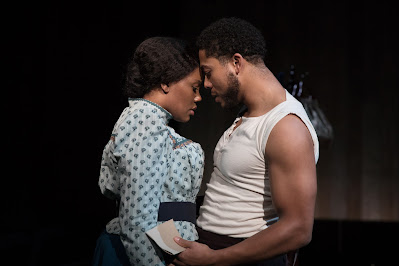
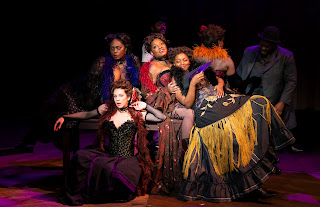
Esther (Kearstin Piper Brown), a lonely, hard working African-American seamstress in 1905 New York, who hopes one day to open a beauty parlor for a black clientele, is wooed by correspondence by George (Justin Austin), a Caribbean worker on the Panama Canal. As Esther can neither read nor write, her responses are penned by two of her very disparate customers, a wealthy white woman Mrs. Van Buren (Naomi Louisa O’Connell) and a black prostitute Mayme (Krysty Swann) who plies her trade in the Tenderloin district. The romantic setup is doomed to sour when George arrives in the city, and it becomes clear after the wedding that George is not what Esther and her romantically-minded clients had imagined based on his letters. But then, neither is she.


All the characters have unfulfilled dreams and are aspirational in one way or another, looking for better lives. 


Brown is tremendous in the lead role, on stage almost every moment, and deeply affecting both vocally and dramatically. (The part is played by Chabrelle Williams on Wednesday and Saturday matinees.) In fact, the cast acts as well as they sing, making a most distinguished ensemble.


Under the assured guidance of director Bartlett Sher, everyone does exceptional work, including Adrienne Danrich as the unsentimentally maternal Mrs. Dickson who runs Esther’s boarding house, and Arnold Livingston Geis as Mr. Marks, the Hasidic fabric merchant in the Jewish ghetto, who is Esther’s true soulmate, both sharing a deep appreciation for fine material, though if they even recognize their fondness for each other as love, it would be a societal impossibility given the religious divide. Their scenes together are lovely.


There are no standalone songs as such, but Gordon’s music is always apt, and period appropriate from the cakewalk infused opening strains onwards. Mayme has a raunchy number about opium which is the closest “Intimate Apparel” comes to musical comedy. (Dianne McIntyre has provided the lively choreography here and elsewhere.)


Music Director Steven Osgood conducts the excellent two piano accompaniment while supertitles are projected on the back of Michael Yeargan’s simple but evocative period sets, with Jennifer Tipton’s expert lighting. Though pianos add to the intimacy, a fuller orchestration would not have been unwelcome. 


Catherine Zuber’s costumes, including the titular “intimate apparel”  perfectly capture the period. There’s ironic humor to be had in the similarity between the garments Esther fashions for Mrs. Van Buren and Mayme. 


Nottage’s words are remarkably clear for the most part, thanks to the cast’s careful enunciation and Marc Salzberg’s exemplary sound design. 


(Mitzi E. Newhouse Theater in Lincoln Center Theater, 150 West 65th Street), Telecharge.com or 212-239-6200; through March 6)


Photos

(Top) Photo by Julieta Cervantes: Kearstin Piper Brown and Justin Austin as Esther and George. Credit to Julieta Cervantes


(Below) Photo by T. Charles Erickson: Krysty Swann (center) and the company


Saturday, March 7, 2020

Madeleine (VHRP Live!)


By Harry Forbes

Alyce Mott’s enterprising company dedicated to all things Victor Herbert risked alienating the operetta regulars by presenting not one of his extravagantly melodic musicals or operettas, but rather his virtually tune-free 1914 one-act “modern” opera.  The piece had debuted at the Met in 1914, sharing the bill with, of all things, “Pagliacci” starring Enrico Caruso, by all accounts, an ill-advised pairing. 

Mott had already broken similar adventurous ground with her spectacular presentation of his 1911 grand opera, “Natoma,” in 2014. But in truth, “Madeleine” was an even more daring venture, as unlike the lush “Natoma,” the work was conceived as an opera in the manner of Richard Strauss or Wolf-Ferrari. There are virtually no stand-alone arias, a fact decried by music critics in 1914. Rather, the whole piece is laid out in conversational structure, heavy on recitative. It’s very much a play set to music.

Herbert’s source was, in fact, a French play by Decourcelles & Thibaut, “Je dine chez ma mere” (I Dine with My Mother), which he had read in the original language, declaring it was just the property for which he was looking for his next project. He translated it himself, but then set actor/playwright Grant Stewart to the task of crafting the actual libretto. Critics complained about the thinness of the source material, yet even Richard Wagner was said to be an admirer of the original play.

The plot, such as it is, concerns a famous opera diva Madeleine Fleury (Claire Leyden) who, at the start, is happily anticipating celebrating a New Year’s Day dinner with one of her many admirers. These include Chevalier de Mauprat (Thomas Woodman), François, Duc d’Esterre (Andrew Klima), and struggling artist Didier (Jonathan Hare), the last a dear childhood friend. She is attended by her maid Nichette (JoAnna Geffert), and other servants including Germain (Keith Broughton), a footman (Shane Brown), and a coachman (David Seatter). Everyone -- including an offstage baron -- ends up declining Madeleine’s invitation and all for the same reason: a tradition of dining with their mothers. When lastly, Didier reminds her of their happy times together as children, Madeleine, who till then had been behaving very peevishly about her friends’ perceived disloyalty, softens, and decides she’ll dine alone after all...with the restored portrait of her mother with which Didier has just presented her. A lovely melodic theme, associated with the portrait, ends the roughly 55-minute work.


What made the slight plot so compelling on this occasion were the lively and intelligent staging by Mott, a fine cast, a particularly absorbing performance by Leyden who pulled out all the stops vocally and dramatically, and an excellent group of musicians playing, not an arrangement, but a savvy reduction of Herbert’s original. Of course, the Met’s orchestra numbered 57 players. But with conductor Jestin Pieper and music director and pianist William Hicks at the fore, leading a violin, cello, bassoon, and harp, the sound was still richly textured. 

One was able to appreciate Herbert’s superb orchestration, with its myriad leitmotifs, about 20 in all, for different characters as well as some inanimate objects such as a necklace. So even when stage action was at its most minimal, the orchestra was alive with colorful detail and, yes, drama, with the result anything but static. 

Leyden brought splendid conviction to the part of the lonely and increasingly angry heroine, in addition to lustrous vocal sheen from her opening offstage cadenza to her final poignant moments in front of her mother’s portrait. Her singing of “A Perfect Day,” the sole traditional aria in the piece (and one demanded by Met star Frances Alda), was exquisite. It is a demanding part, as Madeleine is almost never offstage, but Leyden never flagged. 

The cast was altogether on top of Herbert’s difficult score, and the dramatic demands of the text. Klima was especially good conveying the Duke’s eager demeanor as he presents Madeleine with some new horses for her stable, but then extreme discomfort when he finds himself the butt of her wrath. Hare was likewise outstanding as he awakened tender memories in the unhappy heroine. And Geffert was also very persuasive as Madeleine’s devoted maid.

Of the original, critic Richard Aldrich had written: “...the character of the English diction heard in the performance, was not such as to bring the literary quality of the text home to the listeners, or make it matter much what that quality was.” 

Such was happily not the case here. Some high-lying sections notwithstanding, diction was remarkably clear throughout. 


The piece proved conclusively another strong affirmation of Herbert’s amazing versatility. That he could write so impressively in the operatic idiom, so stylistically different from those 45 light musical theater pieces he created between 1894 and 1924, continues to astonish. 

The 18th century setting of the original was not reflected in the costumes, and the piece might as well have been taking place in modern day. But Leyden looked smashing in her burgundy gown, Geffert was decked out in maid attire, and evening dress sufficed for the rest.

The presentation was bookended by an enlightening discussion with Mott, Pieper, and Hicks about the musical aspects of the opera, and a Q&A with the whole cast.

At its premiere, “Madeleine” was admired more for its craftsmanship than truly taken to heart either by audiences or the music press, but based on this admirable mounting, I believe critical consensus today would be far different.


The production certainly vindicated Mott’s faith in it, and post-show audience buzz was positive. Melody in Herbert’s traditional vein, however, will return on May 5th and 6th with VHRP’s “Mlle. Modiste,” which will conclude VHRP’s impressive French-themed season.

(Victor Herbert Renaissance Project Live!, Christ & St. Stephen’s Church, 120 West 69th St.; www.vhrplive.org; March 3 and 4 only)


Photos by Jill LeVine:


Top to bottom:


Remember our childhood together
Didier, Madeleine
Jonathan Hare, Claire Leyden


A Lover’s Greeting
Andrew Klima as the Duc d’Esterre, Claire Leyden as Madeleine


The New Victor Herbert Orchestra takes a bow
Jestin Pieper, conductor; Christopher Lee, violin; Lisa Alexander, bassoon; Clay Ruede, cello; William Hicks, music director and pianist; hidden with Harp, Susan Jolles.


Madeleine dines with her mother
Claire Leyden


The Company of Madeleine

L-R  Jestin Pieper, David Seatter, JoAnna Geffert, Jonathan Hare, Andrew Klima, Claire Leyden, Thomas Woodman, Keith Broughton, William Hicks, Shane Brown, Jordan Liau, Alyce Mott

Thursday, June 28, 2018

Carmen Jones (Classic Stage Company)


By Harry Forbes

The revival of Oscar Hammerstein II’s very clever 1943 updating of Bizet’s “Carmen” -- a big hit in its day and one which had the critics outdoing themselves for superlatives -- is receiving a quite wonderful small-scale revival at CSC.

When the show first opened on Broadway, “The New York Tribune” declared the show was “as wonderful and exciting as it is audacious,” and found the libretto “brilliantly translated.”

“The Daily News” concurred that it “...rates all the adjectives that hurried fingers can find on a midnight keyboard. It is superb; it is enchantingly beautiful: it is musically exciting and visually stirring...Hammerstein, the best lyric writer in the business, has done a poet’s and a musician’s job with the libretto. His incandescent imagination sets your own afire.”

Indeed he did. And all these years later, I believe the show registers as worthy as ever.

Directed by John Doyle, whose last Hammerstein venture for CSC was the not-so-hot “Allegro” (Rodgers & Hammerstein) which, as I recall, had followed not long after a far superior staging by the Astoria Performing Arts Center. This occasion, however, finds Doyle at his best, eliciting strong performances from all, and staging the in-the-round presentation ingeniously. His work is wonderfully complemented by Bill T. Jones’ choreography which allows a seamless flow from scene to scene.

Compared to the lavish original Broadway production with its huge cast and full orchestra, CSC’s production is a chamber version with merely a six-piece band led by Music Director Shelton Becton, and a talented cast of 10. But no matter; the power of the piece remains undiminished. And one appreciates anew Hammerstein’s apt lyrics -- in the Negro vernacular of the period -- and holding up very well indeed. Like the original Opera-Comique version of “Carmen,” Hammerstein employed spoken dialogue, not recitatives, between numbers. Those were, in fact, composed after Bizet’s death as Hammerstein had defensively pointed out in a program note back in the day.

Besides the terrific 1954 Otto Preminger film with Dorothy Dandridge and Harry Belafonte, I had previously seen Simon Callow’s exciting 1991 version at London’s Old Vic (which actually won the Best New Musical Olivier Award, as it was the show’s West End premiere) and was justly acclaimed, and York’s brief but excellent 2001 mounting in its Musicals in Mufti series which had featured Anika Noni Rose as good girl Cindy Lou, who loves soldier Joe.

On this occasion, Rose plays Carmen, displaying impressive operatic chops (as does the rest of the cast), and gives as good a dramatic performance as she did as Maggie in the 2008  “Cat on a Hot Tin Roof.” She doesn’t overdo the hip-swiveling vamp aspects of the role, but she’s plenty sultry, sinuous, disdainful and, when confronted by a murderous Joe at the end, bravely defiant. The men in her circle are strongly played and sung by Clifton Duncan as Joe who deserts the army for love of her (his Flower aria most sensitively sung, and his fury in the later scenes powerful), David Aron Damane as prizefighter Husky Miller (Bizet’s Toreador song transformed into the rousing “Stan’ Up and Fight”) and Tramell Tillman as Joe’s commanding Sergeant Brown who lusts after Carmen himself.

Soara Joye-Ross as Carmen’s friend Frankie makes “Beat Out Dat Rhythm on a Drum” a real showstopper, teasingly flirting with the patrons in the front row and aisles, while Lindsay Roberts makes a lovely Cindy Lou, Joe’s hometown gal, and convincingly shows her backbone when she comes to take Joe home. Other multiple roles are taken expertly by Erica Dorfler, Justin Keyes, Andrea Jones-Sojola, and Lawrence E. Street.

Scott Pask’s scenic design -- effortlessly morphing from army base to Billy Pastor’s to a Chicago country club, and so on -- makes ingenious use of boxes and crates, and at one point, a voluminous parachute doubles as a tent (a striking coup de theatre). Ann Hould-Ward has provided vivid costumes (Carmen’s red dress, Husky’s purple robe really pop), and there’s superb lighting by Adam Honoré and fine sound design by Dan Moses Schreier

Joseph Joubert’s  reduced orchestrations -- led by Music Director Shelton Becton -- are just right for this space. And though the book is trimmed and the show clocks in at 95 intermission-less minutes (shades of Peter Brook’s famous 1981 reduction of “Carmen” as “La Tragédie de Carmen"), nothing of consequence, at least that I can recall, is missing.

Get thee to 13th Street!

(CSC, 136 East 13th Street; classicstage.org, 212-352-3101 or 866-811-4111; through Sunday, July 29)

Pictured: David Aron Damane & Anika Noni Rose.  Photo by Joan Marcus

Monday, June 12, 2017

Operetta Update (Light Opera of New York and Victor Herbert Renaissance Project Live!)


By Harry Forbes

As chance would have it, two of the Big Apple’s most dedicated operetta companies -- VHRP Live! and LOONY -- presented noteworthy events just a couple of days apart from each other at the very same venue, the intimate National Opera Center on Seventh Avenue and 29th Street.

Last Tuesday, VHRP Artistic Director Alyce Mott held forth on the history of Victor Herbert’s “Natoma” (not an operetta at all, actually, but rather a work that laid claim to being the first American grand opera, and as such, quite newsworthy in its day), and the intense rivalry between opera impresario Oscar Hammerstein (grandfather of the celebrated lyricist) who headed the Manhattan Opera Center, and the management of the Metropolitan Opera. The contentious backdrop to the production of “Natoma” was arguably more dramatic than anything in “Natoma” itself. (In the event, the opera ended up being mounted under the auspices of the Philadelphia-Chicago Grand Opera.)

Mott’s compelling talk was illustrated with projections of the original production and the major players behind the scenes, while three excellent singers -- Vira Sykwotzki (Natoma), Sarah Caldwell Smith (Barbara), and Daniel Greenwood (Lt. Paul Merrill) -- were on hand to perform selections from the work, accompanied on piano  by the redoubtable William Hicks.

Mott has certainly been a passionate advocate of the work, and in 2014, presented a spectacular concert reading with an orchestra of 57, and large chorus, not commercially recorded, alas. That presentation made quite a strong case for a work which, in 1911, was greeted with some derision (especially for Joseph D. Redding stilted libretto) by the New York critics. But without an orchestra -- and Herbert’s superbly colorful orchestration -- the modest resources at hand could barely suggest the epic scope of the piece, despite the solid voices and knowing accompaniment.

Still, the history was fascinating, and Mott is a natural storyteller.


On Thursday night, LOONY offered the second edition of “My Song Goes ‘Round the World” after the Hans May song recently resurrected by tenor Jonas Kaufmann in his Sony Classical operetta disc. (The number derives from the title song of a Joseph Schmidt film from the 1930s, and made a stirring finale to the concert. Here and elsewhere, director Gary Slavin blocked his singers for maximum effectiveness.


Julia Radosz, resplendent in a mustard yellow gown, got to do two of the biggest operetta lady numbers, “Meine Lippen” from Lehar’s Guiditta and “Heia, in den Bergen” from Kalman’s “Die Csardasfurstin” and she put them over with pizazz, strolling through the audience and flirting with any man within reach during the former. And she also excelled in a stylish “Someday My Heart Will Awake” from Ivor Novello’s “King’s Rhapsody.”

Baritone John Callison showed his versatility in two contrasting Noel Coward numbers, the rousing “Tokay” from “Bitter Sweet,” and then (though not exactly an operetta number) “(Don’t Put Your Daughter on the Stage) Mrs. Worthington.” Tenor Cameron Smith delivered the Richard Tauber biggie, “Dein ist mein ganzes Herz” and “Indian Love Call” (with Radosz) with distinction. And gamine-like Brooke Schooley handled the coloratura challenges of Delibes “Les Filles de Cadix” and Naughty Marietta’s “Italian Street Song” with ease. Katherine Cecelia Peck ventured into Broadway territory with “The Simple Joys of Maidenhood” from “Camelot” and then sang a heartfelt “Something Wonderful” from “The King and I,” in addition to “Youkali” from Kurt Weill’s “Marie Galante,” and "Bonne Nuit" from "Bitter Sweet."

It was good to hear that and other lesser-known numbers such as the “Valse d’Helene” from “Ordre De l’Empereur,” a 1902 opera-comique of Justin Clerice (Schooley). More rarities of that nature would have been welcome.

Producer Brian Long’s amiable free-form narration attempted to give thematic connection to each grouping of songs, though none was truly necessary. The music said it all.

Matthew Stevens provided sympathetic piano accompaniment.

(http://vhrplive.org/ and http://www.lightoperaofnewyork.org/)

Black and white photo:
Charlotte Ander and Joseph Schmidt in “My Song Goes Round the World” (1934)