Friday, February 25, 2022

The Merchant of Venice (Theatre for a New Audience)


By Harry Forbes


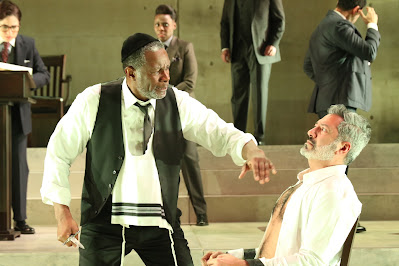
Director Arin Arbus’ production of “The Merchant of Venice” is outstanding in its clarity and fascinating in its take on this problematic play. Above all, it showcases a truly superb performance by the great John Douglas Thompson as Shylock, one of the greatest portrayals of the role I’ve ever seen.


The cast is uniformly excellent, and Arbus has vividly underscored the societal bigotry against Shylock on every level. The result is that the moneylender’s desire for revenge has rarely seemed so justified. A jaundiced view of the Christian characters is, of course, more often than not the usual practice nowadays, but Arbus goes the limit.


Shakespeare scholars like Harold Bloom argue out that, by all rights, Shylock was conceived and ideally should be performed as a comic villain, and that playing the role for noble pathos throws the play off balance, even as it undercuts antisemitism. Nonetheless, Shakespeare has given an actor enough fodder to support the latter interpretation, and Thompson does indeed win our sympathy even when at his most vindictive. None of the Venetian characters emerge as anything approaching heroic. 


Arbus also plays up the homoerotic relationship between Antonio (Alfredo Narciso), the titular merchant, and his friend Bassanio (Sanjit De Silva), Portia’s beloved. One might even question whether Bassanio loves Portia at all, or has merely wooed her for her money. The same can be said of Lorenzo (David Lee Huynh) who elopes with Shylock’s daughter Jessica (Danakya Esperanza) along with her father’s precious ducats. 


The casket scene wherein Portia is approached by three suitors (Bassanio being the last) who, in order to win her hand, must choose which of the three boxes contains Portia’s portrait, are most amusingly handled. First Maurice Jones as The Prince of Morocco, then Varín Ayala as The Prince of Aragon, bedecked in gold medals, who seems more interested in Portia’s steward Balthazar (Jeff Biehl) than in Portia.


This is a diverse production in the best possible way. The casting doesn’t call attention to itself, as all are so perfectly suited to their roles, and create a seamless ensemble. It is said that Thompson is the first Black actor to play Shylock at a professional theatre in New York City, the last being the legendary Ira Aldridge in the early 1800s.

Of course, the casting of Thompson subtly makes present-day parallels all the more vivid, and increases the play’s universality. But Shylock’s Jewishness is not diminished in the least. And the play even ends with Shylock and Jessica reciting a mournful Kol Nidre. 

Isabel Arraiza is a compelling Portia, both as a feisty young woman, and in her boyish courtroom disguise. Amusingly, her first appearance is in present day gym workout mode, no shrinking violet she. “My little body is aweary of this great world…”  takes on a droll new meaning.


Besides those already named, there are sharp performances by Shirine Babb as Portia’s gentlewoman Nerissa; Nate Miller as Shylock’s servant Lancelot Gobbo; Graham Winton’s Salerio; Haynes Thigpen’s nastily racist Gratiano; and Yonatan Gebeyehu’s Solanio.


But really, there aren’t enough superlatives to heap upon Thompson’s performance, as he runs an impressive gamut of emotions from authoritatively confident to determinedly vengeful to utterly defeated. And, experienced Shakespearian that he is, he delivers all of Shylock’s familiar speeches superbly. 


Arbus directs the pivotal courtroom scene for maximum suspense. The moments leading up to the expected cutting of Antonio’s flesh have rarely seemed so suspenseful. But at all times, Arbus’ choices seem apt. Amid the high drama, there’s comedy and also deep sentiment.


Riccardo Hernandez’s tiered white set lit by Marcus Doshi allows a sensible positioning of actors in all situations. Emily Rebholz’s witty modern-day costumes perfectly embody Arbus’ concept.. 

(Polonsky Shakespeare Center, 262 Ashland Place, Brooklyn; 866-811-4111 or www.tfana.org; through March 6)

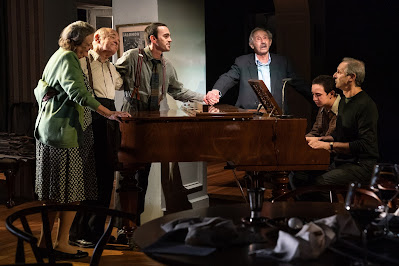
Photo by Gerry Goodstein:  (l.-r.) John Douglas Thompson, Alfredo Narciso.

Saturday, February 19, 2022

Prayer for the French Republic (Manhattan Theatre Club)


By Harry Forbes

So is it safe for Jewish people to live in France? And is there, in fact, anyplace in the world truly free of antisemitic sentiment? Is Israel the answer, even with all the attendant dangers of the Middle East? Such are the themes percolating throughout Joshua Harmon’s intriguing three-act, three-hour-plus, new play.


The narrative concerns a French Jewish family -- psychiatrist Marcelle (a dynamic Betsy Aidem) Benhamou, her physician husband Charles (Jeff Seymour) who, as a child, emigrated from Algeria with his mother, their feisty, bipolar daughter Elodie (Francis Benhamou), and latterly observant instructor son Daniel (Yair Ben-Dor).


Distant American cousin Molly (Mollly Ranson), in France to study the language, becomes their weekend house guest, and falls for Daniel. Marcelle’s non-religious brother Patrick (Richard Topol) serves as a narrator throughout the play explaining how their father had inherited a generations-old piano store which the family still owns, and offering a history of anti-Semitism along the way. 


When Daniel first enters, he is bruised and bloody from having been attacked by ruffians. Marcelle is frantic with concern and wants to call the police, but Daniel adamantly refuses, just as he refuses to wear a concealing baseball cap over his kippah. 


A little later, Charles comes home with a surprising revelation: he doesn’t feel safe in Paris any longer, and wants the family to move to Israel, a notion that Marcelle dismisses out of hand as not only impractical but impossible, given their work and familial commitments particularly regarding her aging father (Pierre Espstein). 


The action takes place in 2016 and 2017, on the cusp of right wing Marine LePen’s possible election, and concurrently, Donald Trump’s in the states, but there are flashbacks to the 1940s where we meet Marcelle and Patrick’s great grandparents, the Salomons, Irma and Adolphe, movingly played by Nancy Robinette and Kenneth Tigar. They are living in their apartment in isolation during the Occupation wondering and worrying about the state of their children who were taken from them. Eventually, son Lucien (Ari Brand) and grandson Pierre (Peyton Lusk) return shocked from the horror they have witnessed during their incarceration. We learn it is Pierre who is Marcelle and Patrick’s father. 


David Cromer directs the epic story with a sure hand, and performances are all superb. We can believe they are an actual family. Everyone speaks unaccented English, but we know they are meant to be speaking in French.


For such a heavy duty topic, Harmon keeps things relatively light most of the time, and even with two intermissions, the time flies by, and the play is never less than absorbing. The family relationships are at first a little confusing, even with Marcelle spelling it all out for Molly not once, but twice. Still, eventually, we connect the dots.


Takeshi Kata’s turntable set, lit by Amith Chandrashaker, encompasses the Benhamou upscale apartment, and the Salomon’s wartime refuge.  Sarah Laux has designed apt costumes for both eras, while Lee Kinney and Daniel Kluger’s sound design is a model of clarity..


It’s a thought provoking play, and its themes must surely resonate with Blacks and Asians, and indeed with any group living with discrimination. Though Harmon’s dialogue is bright and funny, particularly Elodie’s rapid-fire and didactic rants, the themes are certainly trivialized, with many deeply moving moments along the way. 


(New York City Center – Stage 1, 131 West 55th Street; www.nycitycenter.org or 212-581-1212; through March 13)


Photo by Matthew Murphy: Nancy Robinette, Kenneth Tigar, Ari Brand, Pierre Epstein, Peyton Lusk, and Richard Topol

Tuesday, February 15, 2022

Intimate Apparel (Lincoln Center Theater)


By Harry Forbes

Composer Ricky Ian Gordon has found the music inherent in Lynn Nottage’s acclaimed 2003 play of the same name, and with Nottage herself fashioning the libretto (necessarily streamlining the play to make way for the music), has come up with a compelling modern chamber opera. 


The work is the result of a collaboration between Lincoln Center Theater and the Metropolitan Opera as part of their New Works Program, and, as such, voices are of a high level indeed, 


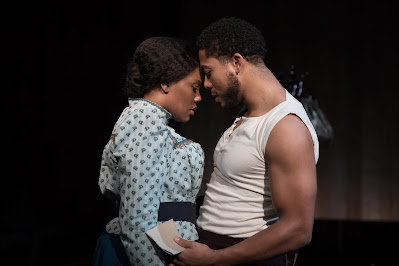
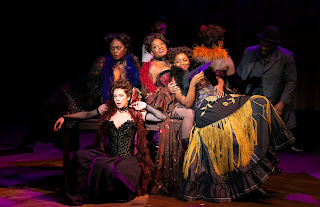
Esther (Kearstin Piper Brown), a lonely, hard working African-American seamstress in 1905 New York, who hopes one day to open a beauty parlor for a black clientele, is wooed by correspondence by George (Justin Austin), a Caribbean worker on the Panama Canal. As Esther can neither read nor write, her responses are penned by two of her very disparate customers, a wealthy white woman Mrs. Van Buren (Naomi Louisa O’Connell) and a black prostitute Mayme (Krysty Swann) who plies her trade in the Tenderloin district. The romantic setup is doomed to sour when George arrives in the city, and it becomes clear after the wedding that George is not what Esther and her romantically-minded clients had imagined based on his letters. But then, neither is she.


All the characters have unfulfilled dreams and are aspirational in one way or another, looking for better lives. 


Brown is tremendous in the lead role, on stage almost every moment, and deeply affecting both vocally and dramatically. (The part is played by Chabrelle Williams on Wednesday and Saturday matinees.) In fact, the cast acts as well as they sing, making a most distinguished ensemble.


Under the assured guidance of director Bartlett Sher, everyone does exceptional work, including Adrienne Danrich as the unsentimentally maternal Mrs. Dickson who runs Esther’s boarding house, and Arnold Livingston Geis as Mr. Marks, the Hasidic fabric merchant in the Jewish ghetto, who is Esther’s true soulmate, both sharing a deep appreciation for fine material, though if they even recognize their fondness for each other as love, it would be a societal impossibility given the religious divide. Their scenes together are lovely.


There are no standalone songs as such, but Gordon’s music is always apt, and period appropriate from the cakewalk infused opening strains onwards. Mayme has a raunchy number about opium which is the closest “Intimate Apparel” comes to musical comedy. (Dianne McIntyre has provided the lively choreography here and elsewhere.)


Music Director Steven Osgood conducts the excellent two piano accompaniment while supertitles are projected on the back of Michael Yeargan’s simple but evocative period sets, with Jennifer Tipton’s expert lighting. Though pianos add to the intimacy, a fuller orchestration would not have been unwelcome. 


Catherine Zuber’s costumes, including the titular “intimate apparel”  perfectly capture the period. There’s ironic humor to be had in the similarity between the garments Esther fashions for Mrs. Van Buren and Mayme. 


Nottage’s words are remarkably clear for the most part, thanks to the cast’s careful enunciation and Marc Salzberg’s exemplary sound design. 


(Mitzi E. Newhouse Theater in Lincoln Center Theater, 150 West 65th Street), Telecharge.com or 212-239-6200; through March 6)


Photos

(Top) Photo by Julieta Cervantes: Kearstin Piper Brown and Justin Austin as Esther and George. Credit to Julieta Cervantes


(Below) Photo by T. Charles Erickson: Krysty Swann (center) and the company


Friday, February 4, 2022

Skeleton Crew (Manhattan Theatre Club)


By Harry Forbes

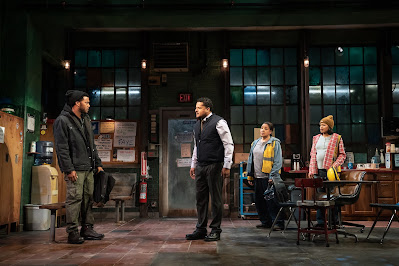
Dominique Morisseau’s affecting play, which premiered at the Atlantic Theater Company in 2016, concerns Detroit workers facing the imminent closure of their auto factory circa 2008. We observe the four-hander’s characters in the break room as they grapple with as yet unsubstantiated rumors about the closing. Foreman Reggie (Brandon J. Dirden) knows what’s coming, but tries to keep it from the others until he can formulate the best approach to dealing with management. 


He confides in longtime worker Faye (Phylicia Rashad), union rep (and longtime family friend) who, unbeknownst to the others, has fallen on hard times, but he swears her to silence. Meanwhile, malcontent Dez (Joshua Boone), suspicious of white-collar Reggie and management alike, banters with the pregnant perennial optimist Shanita (Chanté Adams) who wards off Dev’s flirtations.


Michael Carnahan's realistic breakroom set is surrounded by a proscenium with factory imagery projections. Breakdancer/choreographer Adesola Osakalumi provides the opening scene-setting and reappears throughout between scenes, representing both the workers and the mechanical nature of their jobs. Though he and Nicholas Hussong’s accompanying projections are skillfully done, the play would be just as effective without the glitzy framing. Emilio Sosa’s costumes are satisfyingly authentic.


The first act, which takes its time laying out the stakes while teasing certain plot turns to come, ends on a dramatic note, as Dev refuses to allow a routine, random search of his bag. (We learn early on that he’s packing a gun.) But the second act grips from start to finish, culminating in a genuinely moving wrap-up.


MTC Artistic Advisor Ruben Santiago-Hudson, who so superbly performed his own “Lackawanna Blues” recently in the same space, directs his excellent cast with a sure hand. 


Rashad, in an impressive change of pace, convincingly embodies her tough chain-smoking lesbian character. Dirden beautifully conveys the compassion behind the by-the-rules supervisor. Adams, currently on screen in the Denzel Washington directed film, “A Journal for Jordan,” shines here also in a radically different sort of role. Boone is likably empathetic as the prickly young man.


I have to admit there were some not inconsiderable audibility issues for a good part of the evening, not only because of the Detroit dialect but performances seemed to be pitched at too naturalistic a level. One’s ears eventually adjust and the cast seems to project more clearly by the second act, but much of Morisseau’s crackling dialogue was lost.


There are thematic similarities to this season’s “Clyde’s” in terms of a close-knit group of workers grappling with a situation out of their control, though there was considerably more humor beneath the pathos in the latter. Like “Clyde’s” playwright Nottage, Morisseau has the knack of writing dialogue that rings absolutely true.


There’s an amusing program insert from Morisseau giving the audience “permission” to give vent to audible reactions and responses, but cautioning not to the extent that they unduly distract the actors. At the reviewed performance, there was at least one empathetic response when a character seemed unfairly treated, and some approving murmurs during some sentimental moments elsewhere, but nothing disruptive.


As another program note by Morisseau persuasively indicates, the play now has the added resonance of shedding light Covid-era plight of essential workers. And indeed it powerfully does. 


Samuel J. Friedman Theatre, 261 W. 47th Street; Telecharge.com or 212-239-6200,through February 12)


Photo by Matthew Murphy:


(l.-r.) Joshua Boone (Dez), Brandon J. Dirden (Reggie), Phylicia Rashad (Faye), and Chanté Adams (Shanita)

Sunday, January 16, 2022

Company (Bernard B. Jacobs Theatre)


By Harry Forbes

Even knowing the central conceit of director Marianne Elliott’s clever rethinking of Stephen Sondheim and George Furth’s 1970 “Company” -- that is, recasting bachelor Bobby as bachelorette Bobbie -- didn’t prepare me for the marvelously fresh all round approach.


This production transforms “Company” into virtually a whole new show. For beyond the gender switching, Elliott’s staging is consistently inventive, and David Cullen’s new orchestrations give Sondheim’s music a bracing sheen.


The casting is strong. Katrina Lenk makes an appropriately detached but always appealing protagonist facing her 35th birthday at every turn (increasingly large mylar “35” balloons hammer home the point). The major shift of having a woman pressured by her friends to get married brings the show persuasively up to date, along with other cosmetic changes of cell phones and such.


The biological clock is always ticking, and that theme is hilariously illustrated by the “Tick Tock” dance, now a nightmarish vision of what Bobbie’s married future could be. (Liam Steel did the nifty choreography.)


Patti LuPone, the only holdover from the production’s London premiere, gives a wonderfully canny performance. Her Joanne in the PBS “Live from Lincoln Center” concert from 2011 impressed, so it’s no surprise to hear how well she nails “The Ladies Who Lunch” and “The Little Things You Do Together,” and at this point, I think it’s fair to say she owns the role of the hard-drinking socialite as much as originator Elaine Stritch. Her delivery of the “Ladies Who Lunch” to Bobbie now registers as a cautionary lesson.


George Furth’s comic scenes have never played so amusingly, but there’s underlying poignancy as well. When Jamie (formerly Amy) sings his fearful “Getting Married Today” (and Matt Doyle does it superbly at breakneck speed), followed by a nervous conversation with his intended Paul (Etai Benson), the talk suddenly takes a genuinely solemn turn when the depth of Jamie’s love is questioned. It’s a superbly dramatic moment that packs a heartstopping wallop. 


Bobbie observes all of this, along with the concurrent marital bliss and woes of her other married friends Harry (Christopher Sieber) and Sarah (Jennifer Simard), Peter (Greg Hildreth) and Susan (Rashidra Scott), David (Christopher Fitzgerlad) and Jenny (Nikki Renée Daniels), and Larry (fine Tally Sessions at the reviewed performance) and Joanne (LuPone). Apart from Jamie’s gender swap, the couples are played as written, though there’s some up-to-date diversity.


Particular comic standouts include the opening jiu-jitsu scene between on-the-wagon Harry and fitness fanatic Sarah, and the pot smoking between David and Jenny, with the former getting high not his wife as before. Simard and Fitzgerald are particularly delicious in these scenes.


Of course, Bobbie’s three suitors are now perforce male, and the delightful trio “You Could Drive a Person Crazy” is another showstopper as performed by Andy (Claybourne Elder, excellent too in the “Barcelona” scene with Lenk), Theo (Manu Narayan), and PJ (Bobby Conte) who does a fine “Another Hundred People,” originally sung by Marta.\


Bunny Christie’s colorful setting -- including giant letters spelling "COMPANY," and at one point “NYC” for this is, after all, a quintessential New York musical, and a series of increasingly cramped “Alice in Wonderland” rooms --  entertainingly lit by Neil Austin with lots of hot neon.


The sound design by Ian Dickinson for Autograph is exemplary, a rarity these days.


All in all, this rates as one of the very best Sondheim revivals ever. It’s so nice to know that the great man was able to see it before his recent passing. 


(Bernard B. Jacobs Theatre, 242 West 45th Street; Companymusical.com or 212-239-6200)


Photos by Matthew Murphy


Top: (l.-r.) Patti-LuPone and Katrina Lenk


Below: (l.-r.) Christopher Sieber, Jennifer Simard, Katrina Lenk, Patti-LuPone


Thursday, January 6, 2022

Kimberly Akimbo (Atlantic Theater Company)


By Harry Forbes

I didn’t catch the 2003 Manhattan Theater Club production of David Lindsay-Abaire’s play, but the musical he and composer Jeanine Tesori have fashioned from it is a winner, and is being accorded a beautiful production at the Atlantic Theater Company under the direction of Jessica Stone (choreography by Danny Mefford).


The unusual narrative tells of 16-year-old Kimberly who has a rare genetic disorder that makes her age four or five times faster than normal, with an attendant shortened life span. Though she looks far older, she’s still just a teenager, and that aspect is played most convincingly by the great Victoria Clark. 


Kim is the rational center of a dysfunctional family including an alcoholic father Buddy (Steven Boyer), a dreamy, hypochondriac mother Pattie (Alli Mauzey), pregnant and fearful of another genetically challenged child, and a felonious aunt Debra (show-stopping dynamo Bonnie Milligan). The setting is “somewhere in Bergen County, NJ,” and we learn the family had to leave their last residence after an incident not revealed till the second act. Both Boyer and Mauzey do fine work with their multifaceted characters. 


Kim’s nerdy, anagram-loving, tuba-playing pal Seth (standout Justin Cooley) loves her but is sensitive enough not to force himself on her. Their four classmates, characters not in the original play, provide added texture and comic relief, and they are appealingly played by Olivia Elease Hardy, Fernell Hogan II, Nina White, and Michael Iskander.


An amusing subplot involves ex-con Debra recruiting the kids for an elaborate check-forging scheme, luring them with the idea they’ll be able to earn the needed money for flashy costumes for their glee club.


Meanwhile, the class is involved in a science project with each team of two asked to research and explain a disease of their choice. Kim plans to do glaucoma, but her project partner Seth persuades Kim to take on her progeria-like condition, a decision that leads to an emotional crisis for Kim. 


The material is sensitively handled all around. There are no villains here, and even Kim’s dodgy family eventually shows its better side. The unspoken love between Seth and Kim is presented with utmost delicacy so there’s nothing to make an audience squirm given the real-life age difference between Clark and Cooley.


David Zinn’s simple sets effectively encompass everything from the ice-skating rink, to the family’s living room, to the school library, all astutely lit by Lap Chi Chu. Sarah Laux’s costumes are spot on for both the characters and 1999 setting.


The score is another feather in the versatile Tesori’s cap, unfailingly tuneful and running an impressive gamut of styles. Lindsay-Abaire, with whom she collaborated on Broadway’s “Shrek” musical, has supplied the astute, above-average lyrics. “Getting older is my affliction, getting older is your cure,” sings Kim at one point.


Music Director Chris Fenwick leads a seven piece ensemble through John Clancy and Macy Schmidt’s excellent orchestrations.


Though Kim’s mortality issues are never glossed over, the show still concludes on a joyful, affirmative note.


(Linda Gross Theater, 336 West 20th Street; atlantictheater.org or 866-811-4111; through January 15)


Photos by  Ahron R. Foster: 


Top: (l-r) Victoria Clark (Kimberly) and Justin Cooley (Seth)


Bottom: (l-r) Bonnie Milligan (Debra), Olivia Elease Hardy (Delia), Fernell Hogan II (Martin), Michael Iskander (Aaron), Nina White (Teresa), Victoria Clark (Kimberly), Justin Cooley (Seth), Stephen Boyer (Buddy) and Alli Mauzey (Pattie)


Tuesday, December 28, 2021

Clyde’s (Second Stage Theater)


By Harry Forbes

The dominant and most worthy message which you take away from “Clyde’s” is that everyone deserves a second chance. The play is Lynn Nottage’s hilarious, warm hearted, and deeply moving tale about a Pennsylvania truck stop diner run by a no-nonsense, imperious lady named Clyde who’s done jail time for an unspecified but undoubtedly violent crime. She is ferociously embodied by the remarkable Uzo Aduba. 


The play had its premiere in 2019 at the Guthrie Theater. 


Clyde’s kitchen staff is made up of other ex-convicts, who take fervent pride in the diner’s specialty sandwiches and who, under the leadership of the sage-like Montrellous (Ron Cephas Jones), endeavor to create their own perfect sandwich. There’s feisty Letitia (Kara Young), a single mom who stole from a pharmacy for her baby’s needed medicine, but also lifted some opioids while at it; Rafael (Reza Salazar) who held up a bank with a BB gun to buy his girlfriend a Cavalier King Charles Spaniel; and newcomer Jason (Edmund Donovan), the only white worker, and a carryover from Nottage’s “Sweat,” who, in a drunken rage at losing his job, attacked someone with a bat.  


Tish and Raf are reluctant to accept the racist-tattooed Jason as part of the team, and he’s slow to take the same sort of pride in his work, but inevitably, he makes a turnaround. Montrellous’ backstory doesn’t come out till late in the play, but when it does, it’s a fitting revelation for such a saintly character. 


It’s been suggested that Clyde is some sort of Satanic character -- and indeed there are some surprising bursts of hellish flame at times when she’s onstage -- but it seems to me that gruff as she is (“I don’t do pity,” she declares at one point), her autocratic rule of the kitchen is an extreme form of tough love. Still, she resolutely refuses Montrellous’s tempting offers to taste his divinely inspired sandwiches, as if doing so would weaken her hardened shell.


Nottage has already proven her impressive expertise in plays like “Ruined” and “Sweat” but “Clyde’s” demonstrates that she’s a master of comedy as well. Her dialogue really crackles. And for all the genuine humor, she never loses sight of the serious underlying theme. Her characters would not be out of place in a Eugene O’Neill play, and they are no less skillfully drawn, and gorgeously acted by everyone here.


We’ve seen food as a metaphor for redemption before, but it’s an ever appealing theme and when Montrellous tells Tish to put the love for her daughter into a sandwich, it touches the heart.


Takeshi Kata’s working kitchen set is a marvel, and lighting designer Christopher Akerlind and sound designer Justin Ellington have a ball with those fantastical moments when the crew describes their ideal sandwiches in mouthwatering detail. Jennifer Moeller has designed a hilarious series of skintight outfits for the plus size Aduba whose every entrance brings a more outrageous getup. 


The whole has been masterfully directed by frequent Nottage collaborator Kate Whoriskey.


Second Stage has admirably collaborated with various partner groups for weekly thematically related talkbacks with their staff and community members, criminal justice reform advocates, and people with lived experience of incarceration and the criminal justice system.


The final two weeks of the run will be live simulcast starting January 4, and is definitely worth your while if you can’t make it live to the Hayes Theater.


(Second Stage Theater, The Helen Hayes Theater, 240 W 44th Street; 2st.com or 212-541-4516; through January 16)


Photo by Joan Marcus: Uzo Aduba, Kara Young, Ron Cephas, Edmund Donovan, and Reza Salazar