Thursday, March 10, 2022

Zauber der Bohème (Austrian Cultural Forum)


By Harry Forbes

Back in 2020, I covered a press conference announcing the launch of an exhibit in Vienna under the auspices of the University of Music and Performing Art’s Exilarte project. Exilarte is dedicated to “preserve, rehabilitate and display the work of Austrian composers, musicians, and music researchers who deemed ‘degenerate’ by the Nazi regime. The exhibit presented a comprehensive overview of the superstar opera couple of the 1930s, Marta Eggerth and Jan Kiepura, who because of their mixed Jewish heritage, had to flee Europe for New York after the Anschluss.


Among the ancillary activities promised at the time was a restored version of the couple’s most famous film and a worldwide hit, “Zauber der Bohème (The Charm of La Bohème),” which was being outfitted with new English subtitles. (There’s a decent print you can see here on YouTube, but only with those dodgy “auto-generated” English subtitles.)


So in partnership with the Exilarte Center, New York’s Austrian Cultural Forum presented the film on February 24 for one night only at their 52nd Street headquarters, and it proved worth the wait. Introduced by ACF Director Michael Haider, the movie was all the more involving on the big screen, and the subtitles were, of course, a boon to a non-German audience.


After the screening, it’s no exaggeration to say there wasn’t a dry eye in the packed house. The film showed the couple at their best, as they played up and coming singers in Paris cast in Puccini’s opera whose real life story mirrors the opera’s plot. Though, as such, the narrative’s tragic climax is completely predictable, the impact is not a whit lessened. 


What struck me anew about the pair, apart from their impressive singing, was first, what a truly fine film actress Eggerth was, playing beautifully to the camera, and effortlessly telegraphing every emotion with subtlety. It is such a shame that her two MGM films with Judy Garland only barely scratched the surface of that talent. And Kiepura was such a likable and natural presence with his irrepressible exuberance, much like Lawrence Tibbett in his early Hollywood films, one could easily see why he was idolized by thousands. 


Very much adding to the specialness of the evening was the presence of the couple’s son, pianist Marjan Kiepura, and his wife Jane Knox-Kiepura, archivist for all things Eggerth/Kiepura related. After the film, they joined Haider for an intriguing panel discussion, though it took them several minutes to compose themselves after experiencing the film. Haider started things off by explaining how little by little their names appeared less and less in the press as the Nazis rose to power, despite their immense popularity, finally disappearing altogether. His fascinating remarks segued into Kiepura offering an intimate view of life at home with his illustrious parents who were always down-to-earth “real” people.


Adding to the frisson of the event was the fond remembrance of the many events Eggerth herself hosted at the Forum in years past. She died in 2013 at the age of 101 singing with remarkable skill right to the end. There's more to learn about Eggerth on the podcast "Marjan's Musical Soirees."


(Austrian Cultural Forum New York, 11 East 52nd Street; 212-319-5300 or www.acfny.org)


Tuesday, March 8, 2022

The Music Man (Winter Garden Theatre)


By Harry Forbes

New Yorkers have been passing the humongous Winter Garden orange and blue billboard touting Meredith Willson’s classic musical for the many long months of the pandemic shutdown, Now it’s opened at last with its gold-chip stars Hugh Jackman and Sutton Foster intact, not to mention a large and especially lustrous supporting cast.


The city’s last major revival -- a very good one directed by Susan Stroman with Craig Bierko (eerily channeling originator Robert Preston in his vocals) and the late Rebecca Luker -- closed in 2001. But who could resist mounting it for Jackman who, as he has said, has had a lifelong ambition to play con artist Harold Hill?


I do feel that, on the whole, the Stroman production managed a more satisfying mixture of a fresh staging coupled with more fidelity to the heart of the traditional staging. Here, the creative team, including director Jerry Zaks and choreographer Wayne Carlyle (the team that staged the Bette Midler “Hello, Dolly!” revival, along with set designer Santo Loquasto), have determinedly set out for a revisionist approach. While they haven’t radically departed from the spirit of the long-running, award-winning 1957 original, the production does have a decidedly different feel.


For one thing, this is probably the most stylized, dance-heavy “Music Man” we’ve ever seen. The long-limbed Jackman is at least up to the task, gracefully executing all of Carlyle’s fancy footwork. And Foster as Marian, not traditionally a dancing role,  now gets to dance in the big Act 2 opener, “Shipoopi,” and a specially added tap dancing finale. Some of the choreography is admittedly clever, like the impressively coordinated book tossing in “Marian the Librarian.” But much of the staging seems overly busy. In his work for “Dolly,” Carlyle was at least adhering very closely to the original Gower Champion template.


Throughout, Jackman proves himself incredibly lithe and athletic. And he certainly has the measure of the part. Rather like Harry Hadden-Paton in the “My Fair Lady” revival, he sings the role more than traditional Hills, rather than using the more speak-sing delivery as it was written. Only in the climactic footbridge scene where he and Marion finally click and duet on “Till There Was You” and “Goodnight My Someone,” does his voice take on a somewhat pinched and nasal quality.


I didn’t care for the heavily stylized treatment of Hill’s opening “Ya Got Trouble.” Jackman’s dancing and the coordinated movements of the ensemble were well executed but seemed out of keeping with the dramatic situation of Hill subtly conning the Iowa townspeople. 


Foster is costumed and bewigged as the archetypal “spinster” of yore, Marian. She brings not only the aforementioned dancing skill, but deft comic timing, and impressive vocalizing, missing only the easy lustrous high notes of most past Marians. She and Jackman are a good match physically, and when she finally drops the brittle veneer, her tenderness to Jackman is most touching. 


A definite plus here is the deluxe casting of such dramatic heavyweights as Jefferson Mays as Mayor Shinn playing like a bumbling Frank Morgan, Jayne Houdyshell as his imperious wife Eulalie, Marie Mullen as Mrs. Paroo, all superb. Also outstanding are Shuler Hensley (who, interestingly, was Jud to Jackman’s Curly in the National Theatre “Oklahoma!”) as Marcellus, and Remy Auberjonois, the salesman determined to unmask Hill as a fraud. He gives his late scenes real dramatic power. Benjamin Pajak is an adorable lisping Winthrop. And there’s good work, too, from Gino Cosculluela and Emma Crow as young lovers Tommy and Zaneeta. 


The close harmony barbershop numbers were impeccably sung by Phillip Boykin, Nicholas Ward, Daniel Torres, and Eddie Korbich.


There’s been some unnecessary fiddling with the lyrics, most especially “Shipoopi,” with a feminist revision of the lyrics extolling those gals who play hard to get. 


Loquasto’s set -- Grant Wood inspired painted backdrops -- isn’t especially lavish, but does the job. Other production elements are in the top flight hands of Brian MacDevitt (lighting), Scott Lehrer (sound), and Patrick Vaccariello (musical direction). The new orchestrations are by Jonathan Tunick. 


Even with tweaks, “The Music Man” is, as ever, a fine show, and a radically innovative one too. Those who label it old-fashioned are missing the great achievement wrought by Meredith Willson who wrote music, lyrics and book. It’s not for nothing that the show trumped “West Side Story” in the Tonys.


Despite the attempts to purge the book of anything that would offend modern-day sensibilities, the show is still a delight, especially with megawatt talents like Jackman and Foster at the helm. And the audience responds with rapturous enthusiasm.


(Winter Garden Theatre, 1634 Broadway; Telecharge.com or 212-239-6200)


Photos by Julieta Cervantes:

(Top) The cast of “The Music Man”

(Below) Hugh Jackman, Sutton Foster


Tuesday, March 1, 2022

The Only Girl (VHRP Live!)

By Harry Forbes


For a work that, for all its cherishable qualities, can hardly be said to rate as one of Victor Herbert’s biggies such as “Naughty Marietta” or “Babes in Toyland,” it is all the more extraordinary that the recent presentation by Victor Herbert Renaissance Project Live! was, in fact, the second New York production in seven years.


The 2015 LOONY production was, in many respects, a more than decent one, with a chamber orchestra ably conducted by Gerald Steichen, and a good cast roughly comparable to the one at hand. It even resulted in an enjoyable CD from Albany Records. However, both that production and recording were undercut by a misguided if well-intentioned new book. 


Leave it to VHRP and its artistic director, Alyce Mott, to set things right by presenting the show, some edits notwithstanding, in its original three-act form with Henry Blossom’s original narrative intact. 


What made “The Only Girl” so singular in 1914, delighting its contemporary critics, was its unique structure as a play with music. There are no extended finales or recitative or choruses: just songs where the plot allows them, and those songs are in a musical comedy vein, not in Herbert’s more familiar operetta style. The show was based on Helen Kraft’s 1912 play “Our Wives,” in turn adapted from an 1897 German comedy, “Jugendfreunde” by Ludwig Fulda. Critics were unanimously pleased with the Blossom-Herbert adaptation. And interestingly, “The Only Girl” was one of the few Herbert works to find favor in London. 


The story concerns Alan Kimbrough (aka “Kim”), a writer in desperate search of a composer with whom to collaborate on his upcoming operetta. When he hears the melodious strains of the show’s evergreen hit, “When You’re Away,” from the apartment below, he’s sure he’s found his man, only to soon learn the melodist is, in fact, a woman, Ruth Wilson (Joanie Brittingham). He and his three buddies nicknamed Corksey (Andrew Buck), Fresh (Jack Cotterell), and Bunkie (Jonathan Fox Powers) have recently sworn to abjure women.  While Kim’s too much of a male chauvinist to entertain the notion of collaborating with a woman, necessity propels him to overcome his reluctance, so he and “Wilson,” as he declares he will call her, will be strictly business partners, and work like two "machines." 


Of course, it isn’t long before his three friends break their vows and fall for women who, in short order,  become their wives: Jane (Alexa Devlin), Margaret (Sara Law), and Birdie (Hannah Holmes), and pretty bossy, domineering ones at that! By the third act, after much farcical business, it can’t be too much of a spoiler to reveal that Kim and Ruth finally recognize their mutual attraction.


Adding some comedy along the way are the antics of showgirl Patrice (aka Patsy) (Emily Hughes), who hopes for a role in Kim’s new operetta, and her actress girlfriends Ruby (Barbee Monk) and Violet (Mariah Muehler). (Even in this semi-staged performance, I did rather wish they, showgirls or not, had worn long dresses more suggestive of the period.) But they sang well, and at one point, Muehler executed a neat bit of juggling with scarves.


The second act has a lot of silly business involving Margaret taking shrill offense with the other wives when they gossip about her possibly dying her hair or wearing a wig.


With all these shenanigans involving the married couples and the showgirls, what should be the central story of Kim and Ruth gets rather shoved aside, so it’s no wonder LOONY had attempted to correct that imbalance. But I much prefer the authentic approach we had here. And we can appreciate how innovative the work must have seemed in its day.


The songs, when they come, are delightful. Among the tuneful highlights are the sextet for the three couples, “Connubial Bliss”; the husbands’ “When You’re Wearing the Ball and Chain” lament; the wives rebuttal  “Why Should We Stay at Home and Sew?”; and the rousing march, “Here’s to the Land We Love, Boys,” all very well delivered. It’s a rather odd circumstance that soubrette Patsy has more songs than Ruth, but Hughes had the voice to put them over.  


Under the sure baton of Musical Director Michael Thomas, the six-piece New Victor Herbert Orchestra played a reduction, not an adaptation (as Mott was careful to point out in her opening remarks), of Herbert’s orchestration. From the sprightly overture onwards, it was clear we were, as ever, in excellent musical hands.


The score seemed complete, only missing “Antoinette,” a brief number for a deleted showgirl character Renée.


VHRP regular Brittingham performed the big number nicely, but positioned as she was, upstage behind an upright piano, the song’s effectiveness was somewhat diminished. Devlin got the show’s second major waltz number, “Tell It All Over Again,” also starting behind the upright, but then at least, moved downstage to finish it. She and Holmes, the latter channeling Julie Halston, were particularly amusing as the pushy wives.  


Sapp seemed to have the lion’s share of dialogue on the male side and handled it exceedingly well, perhaps his most impressive outing yet for VHRP.  In fact, all the men were strong dramatically and vocally, starting with their close harmony rendition of “Be Happy Boys, Tonight.” 


I must not neglect the contribution of veteran performer David Seatter who, in the mostly non singing role of the butler Saunders, made his every moment count, as apparently did the role’s creator John Findlay. 


The audience at my performance responded warmly when Kim and Ruth finally got together at the end to sing the tender “You’re the Only One For Me.” And indeed, this inaugural production at VHRP’s new home at the Theater at St. Jeans attracted a good-sized, enthusiastic crowd. It's wonderful the company now has a proper orchestra pit and traditional stage, rather than having to perform against the backdrop of a church sanctuary. 


Though not a dancing show, Andrea Andresakis supplemented Mott’s direction with some effective staging of the group numbers. 


For those interested in hearing the score, there’s  the aforementioned Albany recording, and also a twin piano version from Comic Opera Guild with the songs in authentic order. 


Next up: the delightful “Mlle. Modiste” April 26 and 27


(The Theater at St. Jeans, 150 East 76 Street; Feb. 22 and 23; www.vhrplive.org or https://vhrp-live.thundertix.com)


Top photo by Karen Hudson: (l.-r.) Joanie Brittingham, Christopher Robin Sapp


Below: Photos by Rachel Monteleone / @MontePhoteaux


(l.-r.)  Jonathan Fox Powers (Bunkie), Jack Cotterell (Fresh),  Andrew Buck (Corksey),


(l.-r.)  Alexa Devlin (Jane), Hannah Holmes (Birdie), Sara Law (Margaret)

(l.-r.) Barbee Monk (Ruby), Emily Hughes (Patsy), Mariah Muehler (Violet) 


Friday, February 25, 2022

The Merchant of Venice (Theatre for a New Audience)


By Harry Forbes


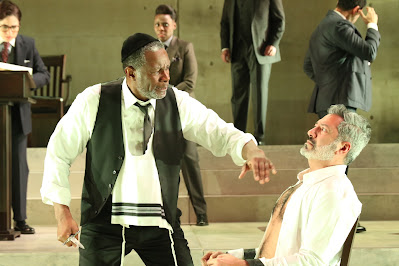
Director Arin Arbus’ production of “The Merchant of Venice” is outstanding in its clarity and fascinating in its take on this problematic play. Above all, it showcases a truly superb performance by the great John Douglas Thompson as Shylock, one of the greatest portrayals of the role I’ve ever seen.


The cast is uniformly excellent, and Arbus has vividly underscored the societal bigotry against Shylock on every level. The result is that the moneylender’s desire for revenge has rarely seemed so justified. A jaundiced view of the Christian characters is, of course, more often than not the usual practice nowadays, but Arbus goes the limit.


Shakespeare scholars like Harold Bloom argue out that, by all rights, Shylock was conceived and ideally should be performed as a comic villain, and that playing the role for noble pathos throws the play off balance, even as it undercuts antisemitism. Nonetheless, Shakespeare has given an actor enough fodder to support the latter interpretation, and Thompson does indeed win our sympathy even when at his most vindictive. None of the Venetian characters emerge as anything approaching heroic. 


Arbus also plays up the homoerotic relationship between Antonio (Alfredo Narciso), the titular merchant, and his friend Bassanio (Sanjit De Silva), Portia’s beloved. One might even question whether Bassanio loves Portia at all, or has merely wooed her for her money. The same can be said of Lorenzo (David Lee Huynh) who elopes with Shylock’s daughter Jessica (Danakya Esperanza) along with her father’s precious ducats. 


The casket scene wherein Portia is approached by three suitors (Bassanio being the last) who, in order to win her hand, must choose which of the three boxes contains Portia’s portrait, are most amusingly handled. First Maurice Jones as The Prince of Morocco, then Varín Ayala as The Prince of Aragon, bedecked in gold medals, who seems more interested in Portia’s steward Balthazar (Jeff Biehl) than in Portia.


This is a diverse production in the best possible way. The casting doesn’t call attention to itself, as all are so perfectly suited to their roles, and create a seamless ensemble. It is said that Thompson is the first Black actor to play Shylock at a professional theatre in New York City, the last being the legendary Ira Aldridge in the early 1800s.

Of course, the casting of Thompson subtly makes present-day parallels all the more vivid, and increases the play’s universality. But Shylock’s Jewishness is not diminished in the least. And the play even ends with Shylock and Jessica reciting a mournful Kol Nidre. 

Isabel Arraiza is a compelling Portia, both as a feisty young woman, and in her boyish courtroom disguise. Amusingly, her first appearance is in present day gym workout mode, no shrinking violet she. “My little body is aweary of this great world…”  takes on a droll new meaning.


Besides those already named, there are sharp performances by Shirine Babb as Portia’s gentlewoman Nerissa; Nate Miller as Shylock’s servant Lancelot Gobbo; Graham Winton’s Salerio; Haynes Thigpen’s nastily racist Gratiano; and Yonatan Gebeyehu’s Solanio.


But really, there aren’t enough superlatives to heap upon Thompson’s performance, as he runs an impressive gamut of emotions from authoritatively confident to determinedly vengeful to utterly defeated. And, experienced Shakespearian that he is, he delivers all of Shylock’s familiar speeches superbly. 


Arbus directs the pivotal courtroom scene for maximum suspense. The moments leading up to the expected cutting of Antonio’s flesh have rarely seemed so suspenseful. But at all times, Arbus’ choices seem apt. Amid the high drama, there’s comedy and also deep sentiment.


Riccardo Hernandez’s tiered white set lit by Marcus Doshi allows a sensible positioning of actors in all situations. Emily Rebholz’s witty modern-day costumes perfectly embody Arbus’ concept.. 

(Polonsky Shakespeare Center, 262 Ashland Place, Brooklyn; 866-811-4111 or www.tfana.org; through March 6)

Photo by Gerry Goodstein:  (l.-r.) John Douglas Thompson, Alfredo Narciso.

Saturday, February 19, 2022

Prayer for the French Republic (Manhattan Theatre Club)


By Harry Forbes

So is it safe for Jewish people to live in France? And is there, in fact, anyplace in the world truly free of antisemitic sentiment? Is Israel the answer, even with all the attendant dangers of the Middle East? Such are the themes percolating throughout Joshua Harmon’s intriguing three-act, three-hour-plus, new play.


The narrative concerns a French Jewish family -- psychiatrist Marcelle (a dynamic Betsy Aidem) Benhamou, her physician husband Charles (Jeff Seymour) who, as a child, emigrated from Algeria with his mother, their feisty, bipolar daughter Elodie (Francis Benhamou), and latterly observant instructor son Daniel (Yair Ben-Dor).


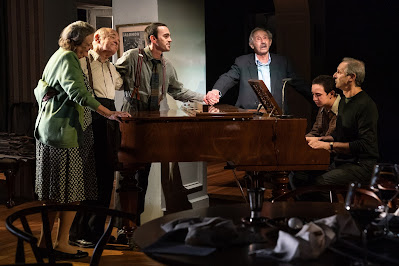
Distant American cousin Molly (Mollly Ranson), in France to study the language, becomes their weekend house guest, and falls for Daniel. Marcelle’s non-religious brother Patrick (Richard Topol) serves as a narrator throughout the play explaining how their father had inherited a generations-old piano store which the family still owns, and offering a history of anti-Semitism along the way. 


When Daniel first enters, he is bruised and bloody from having been attacked by ruffians. Marcelle is frantic with concern and wants to call the police, but Daniel adamantly refuses, just as he refuses to wear a concealing baseball cap over his kippah. 


A little later, Charles comes home with a surprising revelation: he doesn’t feel safe in Paris any longer, and wants the family to move to Israel, a notion that Marcelle dismisses out of hand as not only impractical but impossible, given their work and familial commitments particularly regarding her aging father (Pierre Espstein). 


The action takes place in 2016 and 2017, on the cusp of right wing Marine LePen’s possible election, and concurrently, Donald Trump’s in the states, but there are flashbacks to the 1940s where we meet Marcelle and Patrick’s great grandparents, the Salomons, Irma and Adolphe, movingly played by Nancy Robinette and Kenneth Tigar. They are living in their apartment in isolation during the Occupation wondering and worrying about the state of their children who were taken from them. Eventually, son Lucien (Ari Brand) and grandson Pierre (Peyton Lusk) return shocked from the horror they have witnessed during their incarceration. We learn it is Pierre who is Marcelle and Patrick’s father. 


David Cromer directs the epic story with a sure hand, and performances are all superb. We can believe they are an actual family. Everyone speaks unaccented English, but we know they are meant to be speaking in French.


For such a heavy duty topic, Harmon keeps things relatively light most of the time, and even with two intermissions, the time flies by, and the play is never less than absorbing. The family relationships are at first a little confusing, even with Marcelle spelling it all out for Molly not once, but twice. Still, eventually, we connect the dots.


Takeshi Kata’s turntable set, lit by Amith Chandrashaker, encompasses the Benhamou upscale apartment, and the Salomon’s wartime refuge.  Sarah Laux has designed apt costumes for both eras, while Lee Kinney and Daniel Kluger’s sound design is a model of clarity..


It’s a thought provoking play, and its themes must surely resonate with Blacks and Asians, and indeed with any group living with discrimination. Though Harmon’s dialogue is bright and funny, particularly Elodie’s rapid-fire and didactic rants, the themes are certainly trivialized, with many deeply moving moments along the way. 


(New York City Center – Stage 1, 131 West 55th Street; www.nycitycenter.org or 212-581-1212; through March 13)


Photo by Matthew Murphy: Nancy Robinette, Kenneth Tigar, Ari Brand, Pierre Epstein, Peyton Lusk, and Richard Topol

Tuesday, February 15, 2022

Intimate Apparel (Lincoln Center Theater)


By Harry Forbes

Composer Ricky Ian Gordon has found the music inherent in Lynn Nottage’s acclaimed 2003 play of the same name, and with Nottage herself fashioning the libretto (necessarily streamlining the play to make way for the music), has come up with a compelling modern chamber opera. 


The work is the result of a collaboration between Lincoln Center Theater and the Metropolitan Opera as part of their New Works Program, and, as such, voices are of a high level indeed, 


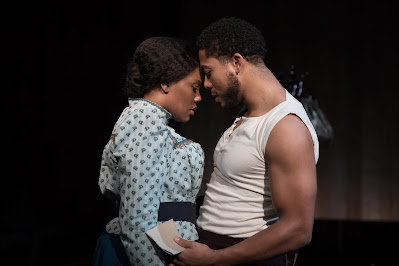
Esther (Kearstin Piper Brown), a lonely, hard working African-American seamstress in 1905 New York, who hopes one day to open a beauty parlor for a black clientele, is wooed by correspondence by George (Justin Austin), a Caribbean worker on the Panama Canal. As Esther can neither read nor write, her responses are penned by two of her very disparate customers, a wealthy white woman Mrs. Van Buren (Naomi Louisa O’Connell) and a black prostitute Mayme (Krysty Swann) who plies her trade in the Tenderloin district. The romantic setup is doomed to sour when George arrives in the city, and it becomes clear after the wedding that George is not what Esther and her romantically-minded clients had imagined based on his letters. But then, neither is she.


All the characters have unfulfilled dreams and are aspirational in one way or another, looking for better lives. 


Brown is tremendous in the lead role, on stage almost every moment, and deeply affecting both vocally and dramatically. (The part is played by Chabrelle Williams on Wednesday and Saturday matinees.) In fact, the cast acts as well as they sing, making a most distinguished ensemble.


Under the assured guidance of director Bartlett Sher, everyone does exceptional work, including Adrienne Danrich as the unsentimentally maternal Mrs. Dickson who runs Esther’s boarding house, and Arnold Livingston Geis as Mr. Marks, the Hasidic fabric merchant in the Jewish ghetto, who is Esther’s true soulmate, both sharing a deep appreciation for fine material, though if they even recognize their fondness for each other as love, it would be a societal impossibility given the religious divide. Their scenes together are lovely.


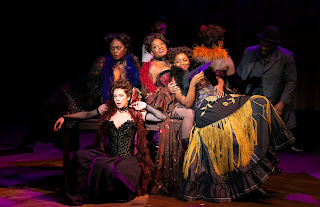
There are no standalone songs as such, but Gordon’s music is always apt, and period appropriate from the cakewalk infused opening strains onwards. Mayme has a raunchy number about opium which is the closest “Intimate Apparel” comes to musical comedy. (Dianne McIntyre has provided the lively choreography here and elsewhere.)


Music Director Steven Osgood conducts the excellent two piano accompaniment while supertitles are projected on the back of Michael Yeargan’s simple but evocative period sets, with Jennifer Tipton’s expert lighting. Though pianos add to the intimacy, a fuller orchestration would not have been unwelcome. 


Catherine Zuber’s costumes, including the titular “intimate apparel”  perfectly capture the period. There’s ironic humor to be had in the similarity between the garments Esther fashions for Mrs. Van Buren and Mayme. 


Nottage’s words are remarkably clear for the most part, thanks to the cast’s careful enunciation and Marc Salzberg’s exemplary sound design. 


(Mitzi E. Newhouse Theater in Lincoln Center Theater, 150 West 65th Street), Telecharge.com or 212-239-6200; through March 6)


Photos

(Top) Photo by Julieta Cervantes: Kearstin Piper Brown and Justin Austin as Esther and George. Credit to Julieta Cervantes


(Below) Photo by T. Charles Erickson: Krysty Swann (center) and the company


Friday, February 4, 2022

Skeleton Crew (Manhattan Theatre Club)


By Harry Forbes

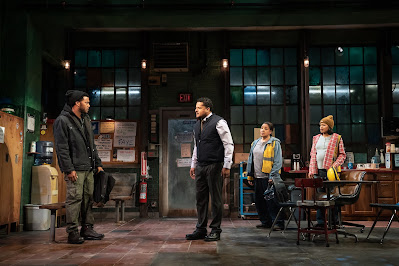
Dominique Morisseau’s affecting play, which premiered at the Atlantic Theater Company in 2016, concerns Detroit workers facing the imminent closure of their auto factory circa 2008. We observe the four-hander’s characters in the break room as they grapple with as yet unsubstantiated rumors about the closing. Foreman Reggie (Brandon J. Dirden) knows what’s coming, but tries to keep it from the others until he can formulate the best approach to dealing with management. 


He confides in longtime worker Faye (Phylicia Rashad), union rep (and longtime family friend) who, unbeknownst to the others, has fallen on hard times, but he swears her to silence. Meanwhile, malcontent Dez (Joshua Boone), suspicious of white-collar Reggie and management alike, banters with the pregnant perennial optimist Shanita (Chanté Adams) who wards off Dev’s flirtations.


Michael Carnahan's realistic breakroom set is surrounded by a proscenium with factory imagery projections. Breakdancer/choreographer Adesola Osakalumi provides the opening scene-setting and reappears throughout between scenes, representing both the workers and the mechanical nature of their jobs. Though he and Nicholas Hussong’s accompanying projections are skillfully done, the play would be just as effective without the glitzy framing. Emilio Sosa’s costumes are satisfyingly authentic.


The first act, which takes its time laying out the stakes while teasing certain plot turns to come, ends on a dramatic note, as Dev refuses to allow a routine, random search of his bag. (We learn early on that he’s packing a gun.) But the second act grips from start to finish, culminating in a genuinely moving wrap-up.


MTC Artistic Advisor Ruben Santiago-Hudson, who so superbly performed his own “Lackawanna Blues” recently in the same space, directs his excellent cast with a sure hand. 


Rashad, in an impressive change of pace, convincingly embodies her tough chain-smoking lesbian character. Dirden beautifully conveys the compassion behind the by-the-rules supervisor. Adams, currently on screen in the Denzel Washington directed film, “A Journal for Jordan,” shines here also in a radically different sort of role. Boone is likably empathetic as the prickly young man.


I have to admit there were some not inconsiderable audibility issues for a good part of the evening, not only because of the Detroit dialect but performances seemed to be pitched at too naturalistic a level. One’s ears eventually adjust and the cast seems to project more clearly by the second act, but much of Morisseau’s crackling dialogue was lost.


There are thematic similarities to this season’s “Clyde’s” in terms of a close-knit group of workers grappling with a situation out of their control, though there was considerably more humor beneath the pathos in the latter. Like “Clyde’s” playwright Nottage, Morisseau has the knack of writing dialogue that rings absolutely true.


There’s an amusing program insert from Morisseau giving the audience “permission” to give vent to audible reactions and responses, but cautioning not to the extent that they unduly distract the actors. At the reviewed performance, there was at least one empathetic response when a character seemed unfairly treated, and some approving murmurs during some sentimental moments elsewhere, but nothing disruptive.


As another program note by Morisseau persuasively indicates, the play now has the added resonance of shedding light Covid-era plight of essential workers. And indeed it powerfully does. 


Samuel J. Friedman Theatre, 261 W. 47th Street; Telecharge.com or 212-239-6200,through February 12)


Photo by Matthew Murphy:


(l.-r.) Joshua Boone (Dez), Brandon J. Dirden (Reggie), Phylicia Rashad (Faye), and Chanté Adams (Shanita)